


For decades, the brightest members of the carotenoid family have attracted most of the attention. Beta-carotene is closely associated with carrots, lycopene has become almost synonymous with tomatoes, and astaxanthin has established a growing following in the supplement and healthy-ageing markets. Yet researchers are now taking a closer look at a far less conspicuous member of the same family: phytoene, a colorless carotenoid naturally present in familiar foods including tomatoes, carrots, oranges and peppers. Once regarded largely as a biochemical stepping stone in the production of other carotenoids, phytoene is emerging as a potentially bioactive compound in its own right.
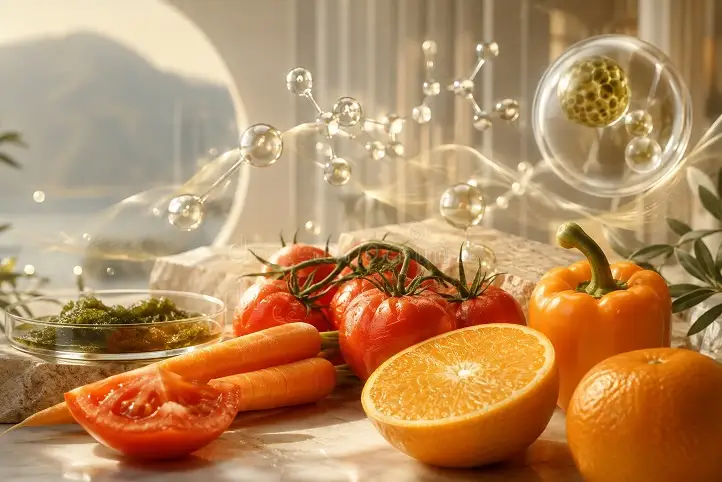
Image Credit: Thailand Wellness News
The excitement follows research involving scientists from the University of Seville in Spain and the University of Kent in the UK, who investigated phytoene using the widely studied laboratory organism Caenorhabditis elegans. Their findings suggest that the compound can influence several biological processes associated with ageing, oxidative damage and protein toxicity. Most strikingly, this Wellness News report highlights that animals receiving phytoene or phytoene-rich microalgae extracts experienced lifespan increases of between 10 and 18.6 percent. The treatments also reduced the toxic effects associated with amyloid-β42 by approximately 30 to 40 percent in the experimental model.
The Colorless Carotenoid Hiding in Plain Sight
Phytoene is unusual because, unlike many carotenoids, it is colorless. Carotenoids are normally recognized for the yellows, oranges and reds they contribute to fruits and vegetables, but phytoene does not provide such visible pigmentation. It is produced early in the carotenoid biosynthesis pathway and ultimately contributes to the formation of compounds such as lycopene and beta-carotene.
That inconspicuous role may partly explain why phytoene has received comparatively little attention in nutritional research. The source material notes that it is frequently regarded simply as a precursor and is often absent from epidemiological assessments of carotenoid intake. Yet previous studies have detected phytoene in plasma and tissues, while dietary research suggests that people may consume it in greater quantities than several carotenoids that have traditionally attracted much more scientific attention.
What Happened When Researchers Tested Phytoene
Scientists examined purified phytoene alongside carotenoid extracts from two microalgae species, Chlorella sorokiniana and Dunaliella bardawil. Both microalgae can accumulate substantial quantities of phytoene and have attracted commercial and scientific interest as sources of carotenoids.
The results were notable across several measures. Supplementation at tested concentrations did not interfere with the worms’ development, helping researchers distinguish the observed lifespan effects from dietary restriction. At concentrations of 1 and 2 micrograms per milliliter, phytoene and the phytoene-rich extracts increased resistance to oxidative stress induced by juglone by 39 to 53 percent.
When researchers turned to a humanized C. elegans model involving amyloid-β42 toxicity, the results provided another reason for interest. At 1 microgram per milliliter, phytoene and the extracts reduced proteotoxic effects by 30 to 40 percent. Lifespan increased by 10 to 18.6 percent, supporting the researchers’ argument that phytoene should no longer automatically be considered biologically inactive.
Why Oxidative Stress Matters in Ageing
Oxidative stress occurs when reactive molecules overwhelm cellular protective mechanisms, potentially damaging proteins, lipids and other components of cells. It is widely studied in connection with ageing and disorders including cardiovascular disease, cancer and neurodegeneration.
Carotenoids are known for their antioxidant properties, but their biological influence can be more complicated than simply neutralizing free radicals. Research involving other carotenoids indicates that some can interact with cellular signaling systems and activate the body’s own protective responses.
Scientists do not yet know precisely how phytoene produces the effects observed in the new experiments. The researchers therefore see understanding its mechanisms as an important next step. Possibilities include direct antioxidant activity and effects on endogenous cellular defense or longevity pathways, but these possibilities require further investigation.
The Alzheimer’s Connection Requires Caution
The reduction in amyloid-β42 toxicity is particularly intriguing because amyloid aggregation is a major feature studied in Alzheimer’s disease. In the worm model used by researchers, accumulation of the protein produces progressive paralysis. Phytoene delayed this damaging effect, suggesting protection against protein toxicity.
However, the distinction between an experimental Alzheimer’s model and Alzheimer’s disease in humans is critical. These results do not demonstrate that eating phytoene-rich foods, taking phytoene supplements or consuming microalgae extracts can prevent or treat Alzheimer’s disease in people.
C. elegans is nevertheless an important biological model. The organism has contributed substantially to research into ageing, genetics and cell biology, making it valuable for identifying mechanisms and compounds worthy of more advanced investigation. Researchers themselves emphasize that further work is needed before the findings can be translated into claims about human health.
Microalgae Could Become Part of the Story
The research also places microalgae in the spotlight. Chlorella sorokiniana and Dunaliella bardawil produced phytoene-rich extracts whose protective effects were comparable with purified phytoene in the experiments.
That finding could have implications extending beyond longevity research. Microalgae grow rapidly, do not require conventional agricultural land and can produce valuable proteins, unsaturated fatty acids, vitamins, minerals and bioactive compounds. The source material notes that microalgae can grow substantially faster than plants while requiring fewer conventional agricultural inputs, creating interest in their use for sustainable food ingredients, supplements and other health-related products.
More Than a Longevity Question
Researchers are already examining phytoene beyond lifespan. Additional work cited in the source material found that phytoene-rich microalgae extracts improved epidermal integrity and strengthened the protective outer barrier in C. elegans. Early-stage experiments using human cell models have also examined phytoene-rich extracts in relation to oxidative damage and reported modest anti-tumor activity in colorectal cancer cells. These findings remain preliminary and should not be interpreted as clinical evidence.
What makes phytoene scientifically compelling is therefore not a single headline result but the possibility that an overlooked dietary compound has measurable biological activity across several experimental systems. It also raises a broader nutritional question: if phytoene has routinely been omitted from studies examining carotenoid consumption, could some health effects attributed to better-known compounds actually reflect a more complex mixture of phytochemicals?
A Promising Discovery, With Much Still to Learn
Phytoene has moved from relative obscurity into an intriguing new chapter of healthy-ageing research. The reported improvements in lifespan, oxidative-stress resistance and amyloid-related proteotoxicity in C. elegans provide a strong rationale for further investigation, while phytoene-rich microalgae offer an additional sustainability dimension. Yet human trials, dose-response research, safety assessment and deeper investigation of biological mechanisms will be essential before researchers can determine whether these experimental benefits translate meaningfully to people. For now, phytoene is best viewed not as a proven longevity treatment, but as an overlooked dietary carotenoid that has given scientists a compelling reason to look much closer.
Reference:
https://www.mdpi.com/2076-3921/13/8/931
Medical Disclaimer: All content published by Thailand Wellness News is based on scientific research and is intended for informational and educational purposes only. It is not medical advice, diagnosis, or treatment. Readers must not attempt to use, apply, or experiment with any protocols, compounds, or therapies mentioned without first consulting a qualified and licensed medical doctor. Many findings discussed are experimental or preliminary, and only a licensed healthcare professional can determine what is safe and appropriate for an individual’s specific medical condition.