


The ice bath has become a striking symbol of modern wellness: a tub of freezing water, a sharp gasp, and a triumphant smile for the camera. Across social media, cold plunges are promoted as shortcuts to faster recovery, stronger immunity, sharper thinking, and better health. But behind the spectacle sits an uncomfortable question: how much of what consumers are buying is supported by science, and how much is expensive marketing dressed in medical language?
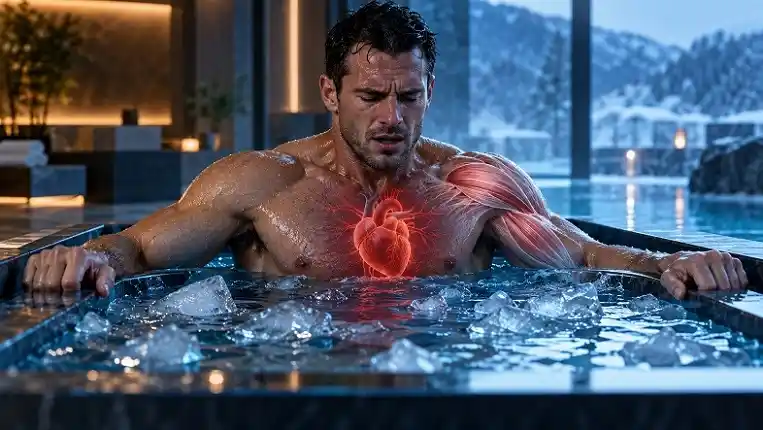
Image Credit: Thailand Wellness News
Cold water immersion involves entering water typically below 59°F, or 15°C, although commercial temperatures and session lengths vary. Its effects depend on the person, the exposure, and the purpose. As research examined for this Thailand Wellness News report shows, cold plunges can have useful applications, but sweeping promises often ignore limitations. Evidence raises particular concerns about routine use immediately after weight training, while medical organizations warn that sudden immersion can place substantial stress on the heart.
When Recovery Works Against Muscle Growth
For people lifting weights to build muscle, the strongest warning concerns timing. Feeling refreshed after a workout does not necessarily mean the body is adapting better to training. A recovery method can reduce discomfort today while interfering with the biological processes that support larger muscles over time.
A 2015 study published in The Journal of Physiology compared cold water immersion with active recovery during a 12-week strength training program. Participants using cold water immediately after training experienced smaller improvements in several measures of muscle size and strength. Separate testing also identified reduced activity in signaling pathways and cells involved in muscle adaptation.
https://physoc.onlinelibrary.wiley.com/doi/abs/10.1113/JP270570
A 2024 systematic review and meta-analysis in the European Journal of Sport Science reinforced the concern, finding evidence that regular postexercise immersion can reduce muscle growth. However, the research involved relatively small studies, mainly young men. It does not establish that every plunge destroys muscle, or that everyone loses half their potential gains.
https://onlinelibrary.wiley.com/doi/10.1002/ejsc.12074
What Cooling Does Inside Muscles
Cold exposure narrows blood vessels and lowers tissue temperature. Researchers have investigated how these changes influence blood flow, amino acid use, and the cellular machinery responsible for producing muscle proteins.
Research led by Maastricht University found that postexercise cooling reduced muscle protein synthesis and the incorporation of protein-derived amino acids into muscle tissue. These findings provide a plausible explanation for impaired growth when cooling repeatedly follows resistance exercise. They do not mean the muscle-building process switches off completely. https://physoc.onlinelibrary.wiley.com/doi/10.1113/JP278996
Strength and muscle size also require separate consideration. A 2019 study found reduced muscle fiber growth without a corresponding reduction in strength gains. For recreational lifters, the practical message is to question whether an immediate plunge serves their training goals. Athletes facing another competition soon may prioritize short-term recovery differently from someone pursuing long-term muscle development.
https://journals.physiology.org/doi/full/10.1152/japplphysiol.00127.2019
The Heart Faces an Immediate Challenge
The initial gasp is often presented as proof that a plunge is working. Physiologically, it is part of the cold shock response. Sudden immersion can rapidly increase breathing, heart rate, and blood pressure, while narrowing blood vessels and increasing the heart’s workload.
The American Heart Association warns that this response can be dangerous, particularly for people with cardiac conditions. An involuntary gasp also creates a drowning risk when the head is submerged. A shallow wellness tub does not remove the danger of inhaling water or becoming unable to respond effectively.
People with heart disease, uncontrolled hypertension, or unexplained fainting should seek individual medical advice before attempting immersion. A reassuring appearance, athletic physique, or previous uneventful session cannot guarantee safety. Chest discomfort, severe breathlessness, dizziness, or faintness should never be treated as milestones to push through for a video or personal challenge.
https://health.clevelandclinic.org/what-to-know-about-cold-plunges
Why Breath Holding Adds Risk
A further concern arises when cold immersion is combined with face submersion or breath holding. Cold shock activates responses that accelerate the heart, while the diving response can slow it. Researchers describe the interaction as “autonomic conflict.”
A physiological review explains how these competing signals can provoke abnormal heart rhythms. This does not mean every head dunk triggers a fatal event, but it gives a clear reason to reject competitive underwater challenges. Practices that combine extreme cold with deliberate breathing manipulation deserve particular caution, especially when participants have unknown cardiac vulnerabilities.
https://physoc.onlinelibrary.wiley.com/doi/10.1113/jphysiol.2012.229864
Feeling Better Is Not the Whole Story
The argument that all ice bath benefits are imaginary also goes too far. A frequently cited 2014 experiment involving 30 men compared cold immersion with warm-water recovery, including a placebo condition presented as a beneficial treatment. Cold immersion and the placebo produced similar outcomes in several measures of strength recovery, pain, and readiness to exercise.
The study demonstrates that expectations can influence recovery experiences. It does not prove every benefit reported across all cold immersion research is psychological. Its participants completed sprint exercise, and its findings cannot automatically be applied to every sport, training schedule, or medical condition.
Broader evidence supports some reductions in soreness and improvements in short-term recovery under particular conditions. The distinction is between feeling ready for another session and improving long-term adaptation. Marketing becomes misleading when it treats these different outcomes as interchangeable, promising better recovery and greater muscle growth without acknowledging the potential tradeoff.
https://journals.plos.org/plosone/article?id=10.1371%2Fjournal.pone.0317615
Inflammation Claims Need Closer Scrutiny
Inflammation is not a single enemy that should always be eliminated. Normal responses to exercise participate in tissue adaptation, while persistent inflammation associated with disease presents a different problem.
However, claims that ice baths invariably block immune cells from entering exercised muscles are overstated. A study involving institutions including Queensland University of Technology, the University of Queensland, the University of Auckland, and the Norwegian School of Sport Sciences compared cold immersion with light cycling after resistance exercise.
Muscle samples collected during recovery showed no significant differences between the treatments in several inflammatory and cellular stress responses. The findings challenge both the sales pitch that plunges reliably eliminate muscle inflammation and the opposing claim that they necessarily halt repair by shutting down that response.
https://physoc.onlinelibrary.wiley.com/doi/10.1113/JP272881
Immunity and Detox Promises Outrun Evidence
A 2025 review from the University of South Australia examined 11 studies involving 3,177 participants. It found no significant immediate improvement in measured immune function after cold immersion. Some findings suggested benefits for stress, sleep, or quality of life, but evidence remained limited and depended on when outcomes were measured.
One cold-shower trial reported less sickness absence, which is different from proving fewer infections. Neither temporary changes in circulating immune cells nor a rush of stress hormones establishes stronger protection against viruses. Conversely, available evidence does not justify declaring that ordinary cold plunging routinely suppresses immunity and causes more infections.
https://journals.plos.org/plosone/article?id=10.1371%2Fjournal.pone.0317615
“Detox” claims deserve similar skepticism. Sellers should identify the substance supposedly removed, the measurement used, and evidence of a meaningful health benefit. Vague promises about flushing waste through the lymphatic system give consumers little that can be checked.
Afterdrop and Nerve Injury Require Perspective
Body temperature can continue falling after substantial cold exposure ends, a phenomenon called afterdrop. Heat transfer between warmer central tissues and colder peripheral tissues, along with circulation changes, contributes to it. Wilderness Medical Society guidance identifies particular concern in people approaching moderate or severe hypothermia; significant afterdrop is not inevitable after every brief plunge.
https://journals.sagepub.com/doi/10.1016/j.wem.2019.10.002
Nonfreezing cold injury can cause lasting pain, altered sensation, and cold sensitivity. However, it is associated especially with prolonged exposure to wet, cold conditions. Evidence does not establish that brief, controlled sessions commonly produce permanent nerve damage. Temperature, duration, circulation, and individual susceptibility matter, and persistent numbness or pain warrants assessment rather than another exposure.
https://www.mdpi.com/1660-4601/18/19/10482
A Better Standard for Wellness
For consumers in Thailand, the central issue is whether providers explain what their service can realistically achieve. A credible operator should discuss screening, supervision, emergency procedures, temperature, and exposure limits. Testimonials and dramatic reactions cannot substitute for those safeguards or for evidence supporting the advertised outcome.
Ice baths deserve neither automatic worship nor blanket dismissal. Their strongest applications are specific, while many commercial promises remain uncertain or exaggerated. Consumers should judge each claim against their own goals, health, and available evidence, especially when muscle growth or cardiovascular safety is involved. Wellness businesses earn trust by explaining limitations as clearly as benefits, rather than selling discomfort as proof of transformation.
Legal Suits
Should any individuals suffer any health issues due to ice baths at any health or wellness spas or centers, hotels or resorts etc, you can take legal action against the providers of these services. Contact your lawyers to initiate legal proceedings.
Additional References:
https://theconversation.com/skip-the-ice-bath-if-you-want-bigger-muscles-258407
https://pmc.ncbi.nlm.nih.gov/articles/PMC9518606
https://www.health.harvard.edu/heart-health/cold-plunges-healthy-or-harmful-for-your-heart
https://share.upmc.com/2025/08/ice-bath-health-risks
https://getfitcraft.com/science/ice-baths-and-muscle-growth
https://www.linkedin.com/pulse/rethinking-recovery-impact-ice-baths-muscle-growth-dylan-walsh-zxwue
https://rspublisher.org/index.php/ijitss/article/view/5085
https://www.tandfonline.com/doi/full/10.1080/23328940.2017.1414014
https://journals.plos.org/plosone/article?id=10.1371/journal.pone.0317615