

Kratom has deep roots in Southeast Asia, where the leaves of Mitragyna speciosa have traditionally been used in several ways. But the modern commercial kratom market is a very different proposition from traditional use. Powders, capsules, beverages, extracts, and increasingly concentrated products are now promoted online, sometimes by wellness personalities who present kratom as a natural answer to pain, anxiety, fatigue, opioid withdrawal, and other health problems. The concern is not simply that these claims may be exaggerated. Kratom contains pharmacologically active compounds capable of producing significant effects on the brain and body, and those effects can include dependence, withdrawal, seizures, liver injury, and other serious adverse events.
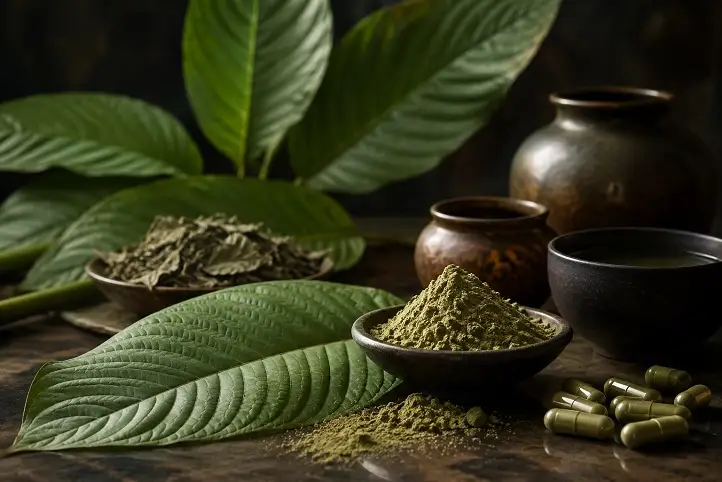
Image Credit: Thailand Wellness News
The appeal is easy to understand. A plant associated with traditional use can sound less intimidating than a prescription medicine, and the words “natural” and “herbal” are powerful marketing tools. Yet natural origin does not establish medical safety, appropriate dosage, product purity, or effectiveness for treating disease. In the United States, the Food and Drug Administration says there are no legally marketed prescription or over-the-counter drug products containing kratom or its known alkaloids, and the agency continues to warn against using kratom for medical treatment. In the middle of an increasingly crowded online wellness marketplace, this Thailand Wellness News report examines why the gap between promotional claims and medical evidence deserves much closer attention.
When Wellness Marketing Runs Ahead of Medical Evidence
A central problem is the way kratom can be presented by people without appropriate clinical qualifications. Consumers encountering social-media posts, videos, testimonials, or product promotions may hear that kratom is a “clean” source of energy, a natural painkiller, an anxiety remedy, or a straightforward way of withdrawing from opioids.
Such claims can create a dangerous impression of certainty.
The U.S. FDA has taken action against companies marketing kratom products with claims related to opioid addiction and withdrawal because those products had not been established as safe and effective treatments. The agency has specifically warned that unproven products may cause people to delay or abandon approved treatment for opioid addiction or withdrawal.
That distinction is crucial. Personal testimonials are not clinical trials, and an influencer’s experience cannot establish a product’s safety for another person with different medications, underlying conditions, dosage patterns, or susceptibility to dependence.
This report highlights the danger of unqualified promoters portraying plant-based products as automatically risk-free while potentially overlooking established medical evidence and the variability of concentrated extracts.
Kratom Has Genuine Pharmacological Activity
Kratom should not be understood as an inert herbal tea. Its leaves contain numerous alkaloids, with mitragynine and 7-hydroxymitragynine, commonly called 7-OH, receiving considerable scientific attention.
According to the U.S. FDA, both mitragynine and 7-OH interact with mu-opioid receptors, the same broad receptor system associated with opioid drugs. The agency also notes that mitragynine has activity involving other brain signaling systems. These pharmacological properties help explain why kratom can produce markedly different effects depending on the product, amount consumed, and circumstances of use.
This is one reason simplistic descriptions of kratom as merely a “natural energy booster” can be misleading. A substance capable of altering multiple neurotransmitter and receptor systems requires substantially more caution than the word “herbal” might suggest.
The U.S. FDA also stresses that much remains scientifically unknown. There have been relatively few well-designed human studies in which kratom itself was administered under controlled conditions. That uncertainty should encourage caution rather than confident therapeutic claims.
Dependence and Withdrawal Are Important Risks
One of the most significant issues surrounding repeated kratom consumption is dependence.
The U.S. FDA reports cases of kratom-related substance use disorder in which people demonstrated behaviors such as taking kratom for longer than intended, consuming more than intended, experiencing cravings, continuing despite harmful consequences, developing tolerance, and suffering withdrawal symptoms after stopping.
This matters particularly when kratom is promoted as an easy alternative for people already struggling with opioid dependence. Replacing one psychoactive substance with another without professional assessment can introduce a new cycle of dependence rather than resolving the underlying disorder.
Withdrawal after regular kratom use has been described in medical literature, and the supplied research material notes symptoms that can include sleep disturbance, muscle discomfort, tremors, nasal symptoms, and psychological distress. The broader message is that repeated exposure to pharmacologically active kratom alkaloids can produce physical adaptation.
Anyone dealing with opioid dependence or another substance-use problem should seek qualified medical care rather than relying on an unverified wellness practitioner or online seller.
Liver Injury Is a Documented Medical Concern
Liver toxicity represents another important area of concern. The National Institutes of Health’s LiverTox resource states that kratom has been linked to rare cases of clinically apparent acute liver injury. Reported cases generally developed after regular use, often within one to eight weeks, and symptoms have included fatigue, nausea, itching, dark urine, and jaundice. The injury pattern is typically cholestatic or mixed and can become severe.
This is an important correction to the assumption that a botanical product cannot seriously affect internal organs. The liver metabolizes an enormous range of substances entering the body, and concentrated botanical compounds can have biologically consequential effects.
At the same time, medical reporting should not exaggerate the evidence. LiverTox describes clinically apparent liver injury associated with kratom as rare and notes that the precise mechanism remains unknown. It also says that kratom is often consumed alongside other agents, which can complicate determining causality in individual cases.
That uncertainty is precisely why consumers should be skeptical of anyone claiming that kratom is universally safe.
Seizures, Confusion and Other Serious Reactions
Neurological effects add another layer of risk. LiverTox reports that higher doses can be associated with agitation, hypertension, breathing difficulty, and confusion, while overdose can involve seizures, coma, and death.
The U.S. FDA likewise identifies seizures among the serious adverse events that have prompted its warnings about kratom.
These concerns become particularly important with concentrated products because consumers may not appreciate how different an extract can be from traditional leaf preparations. The commercial marketplace now includes products with dramatically altered concentrations of specific alkaloids.
In 2025, the FDA took separate action concerning concentrated 7-OH products. Significantly, the agency made a distinction between concentrated 7-OH products and natural kratom leaf products, stating that its scheduling recommendation was specifically directed at certain 7-OH products rather than natural kratom leaf.
That distinction is essential for accurate wellness reporting: “kratom” is increasingly used as an umbrella term for products that may differ substantially in chemical composition and potency.
Product Purity Can Be Another Problem
Even before considering kratom’s inherent pharmacology, consumers face another question: what is actually in the package?
Commercial botanical products can vary in alkaloid content, processing methods, concentration, and manufacturing quality. The FDA has previously warned about kratom products contaminated with Salmonella and concerning concentrations of heavy metals.
In laboratory testing of 30 kratom products, the FDA reported significant concentrations of lead and nickel that exceeded safe exposure levels for oral daily drug intake. The agency warned that heavy long-term users could potentially face risks associated with heavy-metal poisoning, including nervous-system or kidney damage, anemia, and high blood pressure.
This creates a risk that wellness marketing often fails to communicate. Even if a consumer believes they understand the pharmacological effects of kratom itself, they may have far less information about contamination, manufacturing consistency, or the concentration of active compounds in a particular commercial product.
Mixing Kratom with Other Substances Raises Additional Questions
Another important issue is polysubstance use. The U.S. FDA states that deaths have been associated with kratom use in rare cases confirmed through medical examiner or toxicology reports. Importantly, it also notes that kratom was usually consumed together with other drugs in these cases and that kratom’s precise contribution to the deaths remains unclear.
That qualification matters. It would be scientifically irresponsible to attribute every reported kratom-associated death solely to kratom when other substances were present.
However, the presence of multiple substances does not make the issue irrelevant. Instead, it highlights the difficulty of predicting effects when kratom is combined with prescription medications, recreational drugs, alcohol, sedatives, stimulants, or other supplements.
People taking medications should therefore discuss kratom use with an appropriately licensed medical professional rather than assuming that a plant product cannot interact with pharmaceutical treatment.
Why “Natural” Is Not a Medical Safety Standard
The wellness industry frequently uses naturalness as a proxy for safety. Pharmacology does not work that way.
Plants manufacture potent chemical compounds. Whether a substance comes from a leaf, laboratory, fungus, mineral, or pharmaceutical factory does not determine whether it can cause dependence, toxicity, interactions, or organ injury.
What matters is the active compound, concentration, dosage, route of administration, frequency of use, interactions with other substances, manufacturing quality, and characteristics of the individual taking it.
Kratom is an especially useful example of why consumers should demand evidence rather than slogans. Its traditional Southeast Asian history is real, but so are modern concentrated extracts, online marketing practices, changing patterns of consumption, and unresolved scientific questions. Traditional use should not automatically be treated as evidence that every contemporary kratom product, concentration, or therapeutic claim is safe.
Qualified Medical Care Should Replace Internet Guesswork
People experiencing chronic pain, anxiety, depression, opioid dependence, or withdrawal deserve evidence-based care, not unsupported promises.
This does not mean dismissing every question about kratom or pretending that scientific research has answered everything. The FDA itself acknowledges substantial gaps in knowledge and says additional investigation into both safety concerns and potential therapeutic applications would provide valuable public-health information.
That is the appropriate scientific position: investigate the plant and its compounds rigorously while avoiding claims that run ahead of the evidence.
For consumers, the practical warning is straightforward. Be particularly cautious when someone without recognized clinical qualifications claims kratom can cure, treat, detoxify, or safely replace established medical therapy. Ask what evidence supports the claim, whether the product has been independently tested, what concentration is present, what other substances it contains, and whether potential medication interactions have been considered.
Kratom’s Southeast Asian origins and long history should not be used as a marketing shield against legitimate medical scrutiny. Evidence from health authorities and clinical literature shows genuine concerns involving dependence, withdrawal, seizures, liver injury, contamination, and unpredictable effects, while important questions about dose, product composition, interactions, and long-term consequences remain under investigation. Consumers considering kratom for pain, mental-health symptoms, or substance-use problems should discuss those concerns with appropriately qualified health professionals rather than relying on social-media claims or commercial wellness advice. Responsible wellness reporting requires acknowledging both what science has established and what remains uncertain—and challenging anyone who presents an incompletely understood psychoactive substance as a universally safe natural cure.
While Kratom usage is no longer illegal in Thailand, any unlicensed wellness or herbal practitioners advocating its usage can be reported and anyone selling Kratom products not licensed by the Thai FDA can be still prosecuted legally.
Medical References and Further Reading:
https://www.mayoclinic.org/diseases-conditions/prescription-drug-abuse/in-depth/kratom/art-20402171
https://pmc.ncbi.nlm.nih.gov/articles/PMC9130800
https://www.ncbi.nlm.nih.gov/books/NBK548231
https://pubmed.ncbi.nlm.nih.gov/31919755
https://www.frontiersin.org/journals/pharmacology/articles/10.3389/fphar.2022.805986/full
https://www.cdc.gov/mmwr/volumes/75/wr/mm7512a1.htm
https://www.fda.gov/news-events/public-health-focus/fda-and-kratom
https://nida.nih.gov/research-topics/kratom
https://americanaddictioncenters.org/kratom/side-effects
Medical Disclaimer: All content published by Thailand Wellness News is based on scientific research and is intended for informational and educational purposes only. It is not medical advice, diagnosis, or treatment. Readers must not attempt to use, apply, or experiment with any protocols, compounds, or therapies mentioned without first consulting a qualified and licensed medical doctor. Many findings discussed are experimental or preliminary, and only a licensed healthcare professional can determine what is safe and appropriate for an individual’s specific medical condition.