The global wellness industry has built a multi-billion-dollar empire on a single, highly enticing premise: you can indulge in your favorite treats without the guilt. For years, consumer brands have lined supermarket shelves and cafe menus with products boasting terms like “zero sugar,” “sugar-free,” and “keto-friendly.” However, a groundbreaking legal battle taking place across the Pacific has suddenly pulled back the curtain on these labeling practices, exposing a massive regulatory gray area. A high-profile class-action lawsuit filed against coffee giant Starbucks in the United States has sent shockwaves through international markets, raising urgent questions about consumer transparency and corporate accountability.
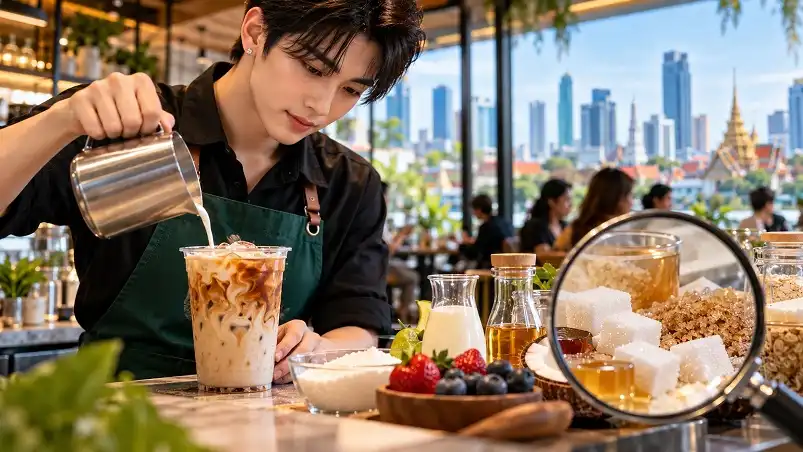
Image Credit: Thailand Wellness News
As news of the American legal dispute spreads, the fallout is reverberating intensely within the Southeast Asian health sector. Analysts at Thailand Wellness News report that local health advocates, food scientists, and regulatory watchdogs are now demanding a sweeping audit of how dietary claims are marketed to Thai consumers. In a city like Bangkok, where wellness culture is exploding alongside a deep-seated love for premium cafes and sweetened beverages, the revelation of potential corporate deception has touched a sensitive nerve. The controversy is forcing a fundamental reevaluation of what truly constitutes a “healthy” choice in an era dominated by clever marketing shortcuts.
The Spark: What Happened in the United States?
The controversy stems from a meticulous class-action lawsuit brought against Starbucks in federal court. The core of the legal complaint centers on the coffee chain’s recently introduced line of wellness-focused beverages, specifically their “sugar-free” protein lattes and botanical cold brews. Starbucks marketed these premium drinks as a guilt-free alternative for fitness enthusiasts, diabetics, and consumers adhering to strict low-carbohydrate diets. The promotional materials heavily emphasized a “0% Added Sugar” formulation, positioning the beverages as the ultimate healthy lifestyle companion.
The legal storm broke when independent laboratory testing, commissioned by consumer advocacy groups, revealed that a single serving of these “sugar-free” drinks contained up to 18 grams of total sugar. The discrepancy did not come from traditional cane sugar or high-fructose corn syrup, which Starbucks had indeed omitted. Instead, the sugar content was derived entirely from natural lactose found in the ultra-filtered milk proteins and the concentrated fruit sugars used to stabilize the botanical flavorings.
While Starbucks legal representatives argue that the company never explicitly claimed the drinks were “calorie-free” or devoid of natural sugars, plaintiffs argue that the prominent “Sugar-Free” branding was deliberately misleading. For a diabetic consumer, the distinction between added sucrose and naturally occurring lactose is irrelevant; both cause a significant spike in blood glucose levels. The American lawsuit argues that by capitalizing on popular health buzzwords while hiding the actual glycemic impact in fine-print disclosures, the corporate giant engaged in deceptive marketing that jeopardized public health.
The Bangkok Connection: A Cafe Culture Addicted to ‘Health’
To understand why a lawsuit in Seattle is causing panic among beverage executives in Thailand, one must look at the meteoric rise of Bangkok’s luxury cafe and wellness culture. Thailand is currently grappling with a severe public health crisis, characterized by rising rates of type 2 diabetes and obesity, largely driven by the historical overconsumption of highly sweetened beverages like traditional Thai iced tea and milk teas. In response, a massive demographic of affluent, health-conscious urbanites has pivoted toward alternative options.
Walk into any high-end shopping mall in Sukhumvit, Sathorn, or Siam, and you will find dozens of specialty cafes proudly advertising “zero-calorie sweeteners,” “plant-based alternatives,” and “completely sugar-free menu items.” For many Thai consumers, paying a premium price of 150 to 200 baht for a beverage labeled “sugar-free” is viewed as an investment in their long-term health.
However, industry insiders admit that the practices exposed in the Starbucks lawsuit are rampant throughout Thailand’s local beverage sector. Many independent chains and boutique wellness brands routinely use pre-packaged fruit concentrates, flavored syrups, and non-dairy milk formulations that are technically free of added table sugar but are heavily saturated with hidden carbohydrates, maltodextrin, and concentrated fruit fructose. Because consumer trust is highly fragile, the American lawsuit has suddenly armed local consumers with the realization that their favorite “healthy” morning ritual might actually be sabotaging their wellness goals.
The Regulatory Gap: Thailand’s Underfunded FDA Deficit
The Starbucks scandal has highlighted a glaring disparity between consumer expectations and actual regulatory enforcement in Thailand. The Thai Food and Drug Administration (FDA) maintains strict guidelines regarding nutritional labeling on pre-packaged goods sold in supermarkets. However, when it comes to the “ready-to-drink” sector—which includes freshly prepared beverages at cafes, juice bars, and restaurants—the regulations are notoriously relaxed and rarely enforced.
Under current Thai regulations, a cafe is not legally required to provide a comprehensive nutritional breakdown or a verified glycemic index for a customized beverage prepared behind the counter. A business can freely place a sign saying “Sugar-Free Alternative” on its counter based solely on the fact that they use a sucralose or stevia base, completely ignoring the sugar content hidden within the accompanying milk, creamers, or powders.
Local legal experts warn that Thailand’s lack of robust class-action mechanisms makes it incredibly difficult for everyday citizens to hold deceptive brands accountable in the same way American consumers do. Without independent watchdogs conducting random laboratory audits, Thai consumers are forced to rely entirely on corporate honesty—a reliance that the recent global events suggest may be deeply misplaced.
The Future of Transparency: A Wake-Up Call for Thai Brands
As the legal proceedings against Starbucks intensify in Western courts, the forward-thinking segments of Thailand’s wellness industry are choosing to proactively adapt rather than wait for a regulatory crackdown. Forward-thinking Thai entrepreneurs realize that transparency is about to become the ultimate competitive advantage.
We are already beginning to see a shift among elite Bangkok establishments. Some pioneering juice bars and wellness cafes have started implementing QR codes on their menus that link to independent laboratory reports detailing the exact macronutrient breakdown of their beverages, including total sugars versus added sugars.
Industry analysts predict that the businesses surviving this incoming wave of consumer skepticism will be those that treat their customers with absolute honesty. Brands can no longer hide behind ambiguous buzzwords. If a beverage contains natural sugars from oat milk or fruit pulp, that information must be displayed as prominently as the “no added sugar” claim.
Rebuilding Trust in the Glass
The Starbucks US lawsuit is a watershed moment for the global health movement. It serves as a stark reminder that the wellness industry can occasionally prioritize marketability over genuine public health. For Thailand, an emerging powerhouse in the regional wellness space, this controversy should not be viewed as a setback, but rather as an essential evolutionary step.
By demanding clearer labels, elimination of deceptive marketing terminology, and stricter oversight of freshly prepared beverages, Thai consumers can protect both their health and their wallets. True wellness cannot be built on corporate deception; it requires absolute transparency, one strictly verified ingredient at a time.
Reference:
https://www.hbsslaw.com/cases/starbucks-sugar-free-labeling-class-action