


Thailand has spent decades building an international reputation as a leading destination for medical tourism, attracting patients with modern hospitals, experienced physicians, competitive treatment costs, and an increasingly sophisticated healthcare infrastructure. However, behind the country’s thriving medical tourism industry, a far more troubling development is emerging. A growing marketplace for questionable anti-aging treatments, experimental regenerative medicine, intravenous wellness infusions, unregistered injectable peptides, and scientifically unsupported holistic therapies threatens to undermine the credibility of Thailand’s healthcare sector. While reputable hospitals and legitimate wellness providers continue to operate according to established medical standards, the proliferation of aggressively marketed treatments raises serious questions about patient safety, professional accountability, and the effectiveness of regulatory enforcement.
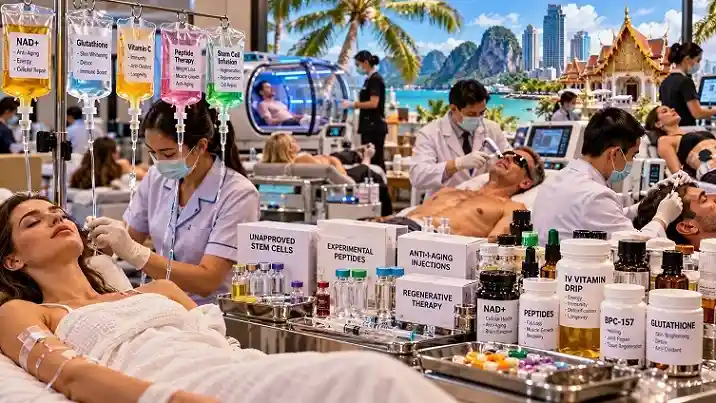
Image Credit: Thailand Wellness News
The concern is that Thailand could eventually develop some of the same characteristics associated with poorly regulated segments of Mexico’s medical tourism market, where certain private clinics have attracted international customers seeking experimental treatments that may not be approved in their home countries. Although Thailand has laws governing medical practitioners, healthcare facilities, pharmaceutical products, and medical advertising, this Thailand Wellness News report examines how questionable operators can exploit gaps between regulatory requirements and actual enforcement. The central issue is not whether Thailand possesses a legal framework, but whether authorities are adequately identifying, investigating, and penalizing those who place commercial opportunities ahead of medical ethics and patient welfare.
Wellness Has Become a Convenient Marketing Label for Questionable Medical Treatments
The word wellness has become one of the most commercially valuable expressions in Thailand’s private healthcare industry. From luxury clinics in Bangkok to exclusive retreats in Phuket and other tourism destinations, businesses increasingly promote services promising rejuvenation, cellular regeneration, immune enhancement, detoxification, longevity, and improved biological performance.
Some wellness interventions, including appropriate nutrition, exercise, stress management, and preventive healthcare, have established scientific foundations. Others occupy a much more questionable territory.
Treatments advertised as reversing biological aging, repairing damaged organs, strengthening immunity through intravenous infusions, or regenerating tissues through experimental cellular products frequently rely on claims that extend well beyond available clinical evidence.
The problem becomes particularly serious when such interventions are presented as established medical treatments rather than experimental procedures or services with uncertain benefits.
Consumers may encounter sophisticated websites, impressive medical terminology, testimonials, celebrity endorsements, and photographs of doctors wearing white coats. These promotional materials can create an appearance of scientific legitimacy even when reliable clinical evidence supporting the advertised benefits is absent.
Patients may consequently spend tens or hundreds of thousands of baht on treatments that offer little demonstrated benefit while exposing themselves to unnecessary medical risks.
Thai Authorities Have Already Identified Illegal Products in the Clinic Industry
Concerns about illegal injectable products are not merely theoretical. In May 2026, Thai authorities announced a major enforcement operation targeting networks involved in the production, importation, and distribution of cosmetic products illegally marketed for injection.
The Thai Food and Drug Administration, working with the Central Investigation Bureau and consumer protection police, seized 35,645 items valued at more than 22 million baht during operations at three locations.
The confiscated materials included 20,596 cosmetic products, 217 unregistered pharmaceutical products, 240 medical devices, and 14,592 labels and promotional materials.
Investigators discovered that certain operators had registered products as cosmetics rather than pharmaceuticals, apparently attempting to circumvent the stricter approval requirements applicable to injectable medicines.
These products were subsequently marketed to aesthetic clinics for injection or other skin treatments, despite not having undergone the necessary assessments for such uses.
Authorities emphasized that cosmetics are not permitted to be injected into the human body and warned that products intended for injection require appropriate evaluations of safety, quality, and effectiveness.
https://thailand.prd.go.th/en/content/category/detail/id/52/iid/505249
The findings demonstrate that illegal medical products can enter commercial distribution networks serving the aesthetic sector, creating risks that may not be immediately apparent to patients.
Illegal Peptides and Experimental Anti-Aging Injections Raise Further Concerns
Another expanding area of concern involves injectable peptides marketed for weight management, skin rejuvenation, muscle recovery, metabolic improvement, and anti-aging purposes.
Peptides are not inherently fraudulent. Certain peptide-based medications have undergone extensive clinical testing and received regulatory authorization for specific medical indications.
However, this does not mean that every injectable peptide promoted by a wellness clinic is safe, effective, or legally approved.
Thailand’s FDA has documented illegal sales of unregistered injectable peptide products through online channels, including messaging groups where sellers promoted injections for weight reduction, fat burning, skin improvement, and slowing aging.
In one investigation, authorities identified online groups with more than 2,600 combined members where products were reportedly sold using coded descriptions intended to conceal their true identity.
https://dis.fda.moph.go.th/detail-newsUpdate?id=3453
A separate enforcement announcement in 2026 described the seizure of injectable peptide products and associated materials valued at more than 52 million baht. Authorities identified suspected violations involving unauthorized pharmaceutical sales and unregistered medicines.
https://dis.fda.moph.go.th/detail-newsUpdate?id=3612
https://www.fda.moph.go.th/news/%E0%B9%80%E0%B8%9B%E0%B8%9B%E0%B9%84%E0%B8%97%E0%B8%94%E0%B9%8C
These cases illustrate how rapidly the commercial market for injectable wellness products can develop, particularly when social media marketing and informal distribution channels make products easily accessible.
Unregistered injectable substances may present additional dangers involving incorrect dosages, contamination, questionable manufacturing standards, inadequate storage conditions, and uncertain long-term effects.
Even when administered by a licensed physician, an unapproved product does not automatically become safe or lawful.
Stem Cell Treatments Are Being Marketed Far Beyond Established Medical Evidence
Stem cell therapy represents another area where legitimate medical science can become entangled with exaggerated commercial promises.
Stem cell transplantation has important, scientifically established applications, particularly in treating certain blood disorders and hematological cancers.
However, these recognized treatments should not be confused with commercially promoted stem cell injections claiming to reverse aging, rejuvenate the entire body, restore sexual performance, repair multiple organs, or prevent chronic diseases.
Thailand’s Department of Medical Sciences has explained that mesenchymal stem cells are subject to specific regulatory requirements. In its published guidance, the department stated that no mesenchymal stem cell products were registered with the Thai FDA at the time of publication and that treatment involving these cells was restricted to research-related purposes under close medical supervision within the applicable regulatory framework.
https://www.dmsc.moph.go.th/th/detailAll/2860/nw/25
This distinction is extremely important. A clinic’s claim that a treatment uses advanced biotechnology does not establish that the procedure is clinically proven or authorized for routine commercial use.
Furthermore, questions about cell sourcing, laboratory processing, sterility, donor screening, product identity, and potential adverse reactions should be central considerations before any cellular material is administered.
Patients may have difficulty obtaining reliable answers, particularly when promotional claims focus almost exclusively on potential rejuvenation benefits.
The United States FDA has also warned about unapproved stem cell and exosome products, emphasizing the potential for adverse events and the danger of patients delaying scientifically established treatments in favor of experimental interventions.
IV Drip Clinics and the Risks of Medical Procedures Being Disguised as Lifestyle Services
Intravenous wellness infusions have become a recognizable feature of the commercial anti-aging industry.
Businesses advertise combinations of vitamins, antioxidants, amino acids, glutathione, and other substances as treatments for fatigue, skin brightening, immunity, detoxification, and general rejuvenation.
While intravenous administration is essential for many legitimate medical treatments, routine wellness infusions in otherwise healthy individuals often lack strong evidence supporting the broad benefits claimed in advertisements.
Unlike ordinary dietary supplementation, intravenous administration delivers substances directly into the bloodstream, bypassing normal gastrointestinal absorption processes.
Potential complications include infections, allergic reactions, vein inflammation, fluid overload, electrolyte disturbances, and adverse effects related to the administered ingredients.
Particular concerns arise when patients receive infusions without adequate medical assessment, appropriate prescribing, informed consent, emergency preparedness, or suitable clinical supervision.
There are also questions about whether every establishment offering these services consistently complies with the professional and facility requirements governing injectable medical procedures.
A nurse’s involvement in administering an infusion does not, by itself, establish wrongdoing. Qualified nurses routinely administer prescribed intravenous treatments in legitimate healthcare settings.
The critical issues are whether a lawful prescription and appropriate clinical assessment exist, whether the nurse is practicing within the authorized scope of nursing, and whether the facility maintains the required medical oversight.
Reports or allegations of physician-absent infusion services in Bangkok’s private wellness market warrant proper investigation rather than assumptions about individual establishments.
Are Some Clinics Using Thai Doctors’ Licenses as Commercial Cover?
One of the most serious regulatory questions concerns the relationship between licensed Thai physicians and the individuals or companies exercising actual control over private medical establishments.
Thailand’s healthcare sector attracts both domestic and international investment, and foreign participation in legitimate healthcare businesses is not inherently improper.
However, potential problems arise if an investor, business manager, consultant, or other individual without appropriate medical authorization effectively directs clinical decisions, recommends prescription-only interventions, or determines treatment protocols while relying on a Thai physician’s credentials to provide an appearance of legitimacy.
Such arrangements would require careful examination of the actual clinical responsibilities, licensing structure, ownership arrangements, and applicable legal requirements.
The distinction between commercial management and medical practice must remain clear.
A business executive may legitimately oversee marketing, staffing, finances, and customer service. That authority does not automatically permit the executive to diagnose illnesses, prescribe medications, or independently direct regulated medical treatments.
In areas such as Sukhumvit, where international wellness businesses compete for affluent residents, expatriates, and medical tourists, regulators should ensure that advertised medical supervision reflects the reality of day-to-day operations.
Any allegation that a clinic is using a physician merely as a nominal license holder, or allowing unauthorized personnel to prescribe treatments, should be investigated through licensing records, clinical documentation, staff qualifications, and firsthand evidence.
Nationality or ethnicity is not evidence of wrongdoing. Regulatory scrutiny must apply equally to Thai-owned and foreign-invested establishments.
A Medical License Should Not Be Mistaken for Expertise in Every Specialty
Another concern involves the public perception that any licensed medical doctor is automatically qualified to perform every procedure marketed by a wellness or aesthetic clinic.
Medical education provides essential foundational knowledge, but competence in a specialized intervention may require additional training, supervised experience, and ongoing professional development.
A physician trained primarily in radiology, general medicine, or another discipline does not necessarily possess the same practical experience as a specialist in dermatology, plastic surgery, endocrinology, or regenerative medicine.
This does not mean that doctors are prohibited from acquiring additional competencies or practicing in related fields where legally permitted.
It does mean that patients should distinguish between holding a general medical license and possessing recognized specialist qualifications relevant to a particular procedure.
For complicated injectable therapies, advanced aesthetic procedures, or experimental regenerative treatments, the practitioner’s training and experience can directly affect patient safety.
Thailand’s Medical Council maintains professional ethics rules and has issued regulations addressing aesthetic advertising, stem cell practices, and medical professional conduct. Its published regulatory materials also include disciplinary standards relating to healthcare facility operators, health products, and advertising violations.
https://tmc.or.th/service_law02_17.php
https://tmc.or.th/service_law02_update.php
The existence of these rules contradicts the suggestion that doctors enjoy unlimited legal immunity. Nevertheless, the effectiveness of any professional regulatory system depends on how consistently violations are detected and sanctioned.
Why Aggressive Wellness Advertising Deserves Greater Scrutiny
Medical advertising has become increasingly sophisticated, particularly through social media platforms, influencer marketing, and international medical tourism websites.
Advertisements may feature dramatic before-and-after photographs, claims of cellular renewal, promises of improved longevity, or references to scientific discoveries that have not been translated into validated clinical treatments.
Sometimes, legitimate scientific terminology is used to support conclusions that the underlying research does not justify.
For example, demonstrating that a substance influences cellular behavior in laboratory experiments does not establish that injecting it into humans will produce meaningful anti-aging benefits.
Similarly, a small uncontrolled clinical study cannot establish the same level of effectiveness as a well-designed randomized trial.
Thailand’s regulatory framework already addresses misleading healthcare advertising.
A legal analysis published in August 2026 described stricter clinic advertising enforcement and noted that terms such as stem cell, cell therapy, anti-aging, IV drip, NAD+, exosome, and chelation appeared on a Department of Health Service Support advertising refusal list.
The analysis also outlined penalties for unauthorized or misleading clinic advertisements, including potential criminal consequences and professional disciplinary action.
https://dejudomlaw.com/th/insight/clinic-advertising-in-thailand-approval-comes-first
Such restrictions underline the difference between legitimately informing patients about healthcare services and marketing treatments through unsupported medical promises.
Thailand Risks Damaging Its International Medical Reputation
Thailand’s medical tourism industry depends heavily on international confidence.
Patients travel to the country expecting competent medical professionals, modern facilities, transparent pricing, and treatment standards comparable with those available in established healthcare markets.
If questionable wellness businesses are allowed to operate alongside reputable hospitals without effective scrutiny, the reputational consequences could extend beyond the individual clinics involved.
A serious complication associated with an unregistered injectable product or an improperly administered experimental therapy could generate international media attention and raise broader concerns about patient protection.
The situation is particularly sensitive because wellness tourism frequently targets consumers who are not necessarily ill.
Healthy individuals may undergo invasive procedures in pursuit of improved energy, better appearance, enhanced immunity, or longer life expectancy, sometimes without fully understanding the uncertainty surrounding the advertised benefits.
The comparison with Mexico should therefore be understood as a warning about regulatory vulnerabilities in segments of international medical tourism, not as a claim that either country’s entire healthcare industry operates without oversight.
Both countries contain reputable medical institutions as well as markets where questionable treatments can attract customers seeking procedures unavailable or restricted elsewhere.
Thailand still has an opportunity to distinguish itself through more transparent regulation, credible scientific standards, and demonstrable enforcement.
Stronger Enforcement and Greater Transparency Are Essential
Addressing these concerns requires more than occasional raids against distributors of illegal medical products.
Regulators should consider systematic inspections of clinics advertising regenerative medicine, anti-aging injections, peptide therapies, and intravenous wellness treatments.
Inspections should examine whether products are properly registered or otherwise legally authorized, whether clinical staff possess appropriate credentials, whether medical records document informed consent, and whether facilities maintain adequate emergency procedures.
Authorities should also scrutinize arrangements in which licensed doctors appear to have little involvement in the clinical operations conducted under their names.
Greater public transparency regarding disciplinary decisions, enforcement actions, and the regulatory status of high-risk treatments would help consumers distinguish credible providers from questionable businesses.
Professional medical organizations could strengthen patient protection by providing accessible guidance explaining which regenerative treatments are established, which remain experimental, and which claims lack adequate scientific support.
Consumers, meanwhile, should be encouraged to verify the medical practitioner’s registration, examine the clinic’s operating license, request the exact identity and regulatory status of injectable products, and obtain independent medical advice before accepting expensive or invasive procedures.
The Future of Thailand’s Wellness Industry Depends on Medical Credibility
Thailand has the expertise, infrastructure, and international reputation necessary to become a genuinely respected global center for evidence-based wellness and preventive healthcare. However, that ambition will be compromised if scientifically unsupported treatments, illegal injectable products, misleading advertising, and questionable clinical arrangements are allowed to flourish under the convenient label of wellness. Recent enforcement operations show that Thai authorities recognize at least some of these problems, but isolated seizures cannot establish how widespread the misconduct is or whether existing oversight is sufficient.
The challenge is to ensure that legitimate innovation is encouraged without allowing experimental medicine to become an unrestricted commercial marketplace. Licensed physicians must remain accountable for their professional decisions, clinic operators must comply with applicable laws, and patients must receive truthful information about both benefits and risks. Unless these principles are consistently enforced, Thailand could find that the pursuit of lucrative wellness tourism ultimately damages the very medical credibility on which its international healthcare industry depends.