


Thailand is preparing to host one of the international wellness industry’s most prominent gatherings, but the upcoming Global Wellness Summit in Phuket is raising important questions about government spending, transparency, accessibility, and who ultimately benefits from the event. With delegate registration reportedly reaching US$6,000 per person, the November 10th–13th, 2026, conference appears designed primarily for wealthy international executives, major healthcare corporations, luxury hospitality operators, and influential investors rather than the thousands of smaller Thai businesses that form the backbone of the country’s wellness industry.
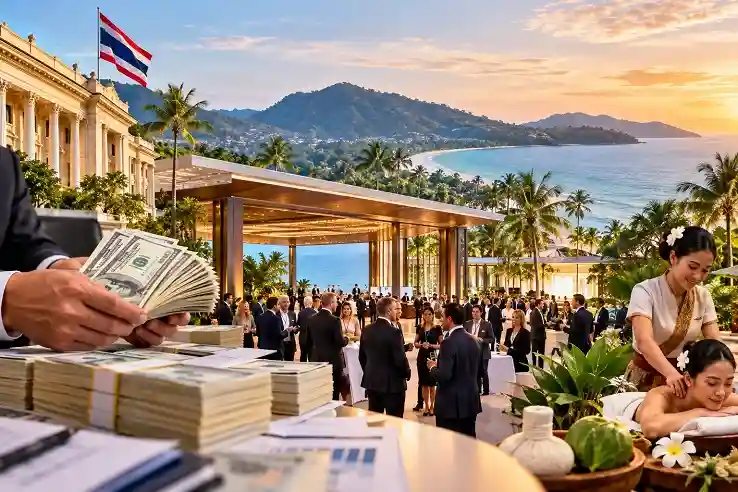
Image Credit: Thailand Wellness News
The Thai government has positioned the summit as a strategic opportunity to strengthen the country’s reputation as a global wellness destination. However, this Thailand Wellness News report examines a fundamental issue that deserves greater public attention: how much taxpayer money and government resources are being committed to supporting a privately organized international conference, and what measurable benefits will ordinary Thai wellness entrepreneurs receive in return? The distinction matters because promoting Thailand internationally is a legitimate government objective, but public expenditure should also be accompanied by financial transparency, accountability, and demonstrable economic benefits.
Government Agencies Are Playing a Major Role
The 20th annual Global Wellness Summit is scheduled to take place at Angsana Laguna Phuket, with several important Thai government organizations associated with its hosting and promotion.
These include the Thailand Convention and Exhibition Bureau (TCEB), the Tourism Authority of Thailand (TAT), and the Ministry of Public Health, particularly its Department of Thai Traditional and Alternative Medicine.
The government’s involvement reflects Thailand’s broader ambition to become a leading international center for preventive healthcare, traditional medicine, wellness tourism, and longevity services.
Officials see international conferences as opportunities to attract investment, establish commercial relationships, and introduce Thailand’s healthcare and wellness capabilities to influential decision-makers.
Nevertheless, an important distinction must be made between supporting an event through promotional partnerships and providing direct financial subsidies.
Government sponsorship can involve cash contributions, promotional expenditure, personnel, transportation, logistical arrangements, security coordination, and other forms of assistance. Each represents a potential use of public resources.
The central question is whether Thai taxpayers have been informed about the full financial value of these commitments.
Where Is the Government’s Actual Spending Figure?
Despite publicity surrounding the summit, a comprehensive, publicly accessible breakdown of the Thai government’s financial commitments has not been established in the information available for this article.
There is no verified consolidated figure showing exactly how much public money is being spent on hosting rights, sponsorship packages, venue arrangements, promotional campaigns, government personnel, and associated activities.
This absence of a confirmed figure should not be mistaken for evidence of financial misconduct. However, it does create a legitimate accountability question.
If public agencies are contributing financially or providing services to an international private conference organizer, the amounts, contractual arrangements, and expected benefits should be available for scrutiny.
Government agencies could address these concerns by publishing the relevant sponsorship agreements, procurement details, approved budgets, and any financial or in-kind commitments.
Such disclosure would establish whether Thailand is receiving reasonable value for its investment.
The 324 Million Baht Economic Projection Needs Closer Examination
Government-related promotional information has cited an anticipated economic impact of at least 324 million baht from the summit, with approximately 500 to 600 international delegates expected.
Expected international delegates.
Dividing 324 million baht by 500 to 600 delegates produces an implied economic impact of approximately 540,000 to 648,000 baht per delegate!
However, without a published methodology, it is difficult to determine precisely how the projection was calculated or how much additional economic activity will actually reach local businesses.
There is also a significant difference between projected economic impact and net economic return to the government.
If substantial public expenditure is required to generate the event, the value of that expenditure must be considered before claims about financial benefits can be properly evaluated.
A US$6,000 Ticket Raises Questions About Accessibility
Perhaps the most controversial feature of the summit is its reported registration pricing.
The standard in-person delegate fee has been listed at approximately US$6,000, with earlier discounted rates reportedly around US$5,350. Other registration options have included a spouse or partner package and paid digital access.
For many Thai wellness businesses, these prices represent a substantial financial barrier.
Small spa operators, traditional Thai massage establishments, herbal product manufacturers, independent wellness practitioners, and community-based tourism businesses may struggle to justify such expenditure, particularly when travel, accommodation, and other costs are added.
Although the summit is positioned as a senior-level business gathering rather than a general public exhibition, that distinction raises another question.
If Thai public agencies are helping finance or facilitate the event, should there not be meaningful opportunities for local businesses to participate without paying international executive-level registration fees?
Subsidized access, dedicated Thai industry sessions, transparent selection processes, and publicly accessible business-matching programs could help ensure that smaller enterprises are not excluded from an event promoted as beneficial to Thailand’s wellness economy.
Who Receives the Money from Registration and Sponsorship?
Another important issue concerns the financial arrangements between the American-based summit organizer, its associated nonprofit foundation, corporate sponsors, and Thai government partners.
The Global Wellness Institute describes itself as a US-registered 501(c)(3) nonprofit educational organization. However, the Global Wellness Summit and the Institute are distinct entities, even though they share historical and organizational connections.
The nonprofit designation does not automatically establish how conference registration revenue is distributed or whether proceeds are transferred to charitable activities.
The summit also markets corporate sponsorship packages. Its published 2026 sponsorship materials advertise certain US$24,000 packages that include promotional exposure and delegate registration.
These commercial arrangements raise legitimate questions about total conference revenue, operating expenditure, management compensation, and the distribution of any financial surplus.
There is no verified evidence presented here that executives receive improper compensation or that conference funds are being misappropriated. Nevertheless, greater financial disclosure would help establish exactly which organizations receive payments and what Thailand obtains in return.
Are Major Healthcare Corporations the only Biggest Winners?
Large healthcare providers and luxury wellness brands are particularly well positioned to benefit from international gatherings of this nature.
Companies such as Bangkok Dusit Medical Services (BDMS), through its wellness-related businesses, operate in sectors closely aligned with the summit’s emphasis on preventive healthcare and longevity.
Other established wellness resorts, hospitality groups, and international investors also have the resources to capitalize on high-level networking opportunities.
However, commercial visibility should not automatically be confused with evidence of preferential government treatment.
The relevant questions are whether sponsorship arrangements provide disproportionate advantages to major corporations, whether smaller Thai enterprises have comparable opportunities, and whether government-supported promotional activities deliver benefits beyond a limited circle of established businesses.
Publishing sponsor benefits, participation criteria, and government-funded promotional arrangements would help answer these questions.
International Recognition Is Not the Same as Medical Accreditation
The Global Wellness Institute has developed an international profile through so called claimed wellness research, industry reports, and professional networking.
However, industry recognition and nonprofit registration are not equivalent to accreditation by a medical bodies or regulatory agancies.
The Institute’s published mission emphasizes research, education, and industry collaboration rather than functioning as a medical licensing or regulatory organization.
Global Wellness Institute
This distinction becomes important when wellness conferences discuss clinical interventions, longevity treatments, and emerging healthcare technologies.
Scientific claims should be assessed against independently verified clinical evidence and applicable medical standards, rather than the prestige of an international conference alone.
The American government itself needs to through a through investigation of this institute and its financials and also the renumeration packages of its so called executives and their qualifications!
Thailand Deserves Answers Before the Summit Begins
Thailand has legitimate reasons to promote its wellness economy, and the Phuket summit could generate valuable international exposure, business partnerships, and investment opportunities.
However, the country’s economic interests must remain central to decisions involving public funding.
The most pressing issue is not whether an international wellness conference should be welcomed, but whether its financial arrangements are sufficiently transparent and its benefits fairly distributed.
Thai authorities should disclose the total value of government support, explain the methodology behind projected economic returns, and clarify how local wellness enterprises can participate.
The summit organizer should likewise provide greater clarity about its commercial arrangements and the relationship between conference income and nonprofit activities.
Without such information, taxpayers cannot adequately assess whether public resources are supporting a broad national economic strategy or primarily subsidizing an exclusive gathering of wealthy international delegates.
The approaching conference provides an opportunity for both government agencies and organizers to demonstrate accountability. Transparency would strengthen the event’s credibility, protect public confidence, and help ensure that Thailand’s wellness ambitions benefit the wider industry rather than only those able to afford a US$6,000 seat.