


Wellness News: As the global wellness industry races to uncover the next breakthrough in healthy aging, an unusual flowering herb from the mountains of Bolivia is rapidly attracting international attention. Known scientifically as Salvia haenkei and more commonly called Prawn Sage, the striking plant is being celebrated by researchers and supplement developers for its remarkable anti-aging potential. Once largely overlooked outside South America, the herb is now emerging as one of the most talked-about botanical candidates in the expanding longevity market.
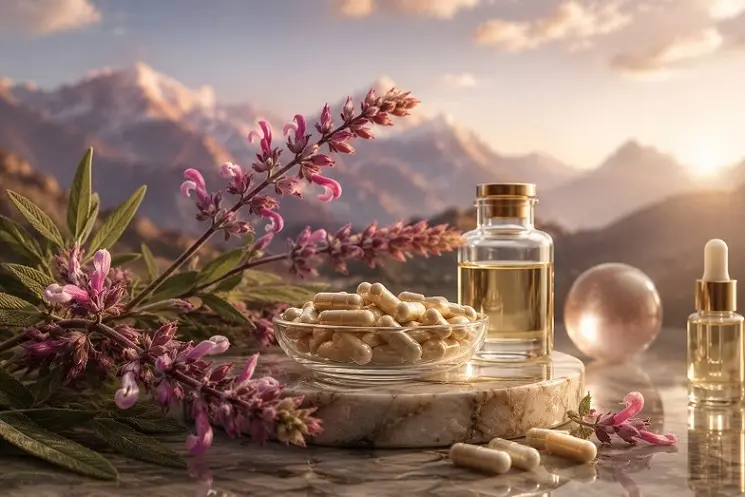
Image Credit: Thailand Wellness News
Native to the harsh Andean regions of Bolivia, Prawn Sage survives in high-altitude environments where intense ultraviolet radiation, temperature fluctuations, and low oxygen levels force plants to develop powerful natural defense systems. Scientists believe these survival mechanisms may explain why the herb contains an unusually rich concentration of bioactive compounds linked to cellular protection and resilience. This Wellness News report has observed a growing scientific and commercial fascination with standardized extracts derived from the plant, especially formulations marketed under the name Haenkenium, which are increasingly being explored for both skincare and oral longevity supplements.
Ancient Botanical Meets Modern Longevity Science
Unlike ordinary culinary sage varieties used in kitchens worldwide, Salvia haenkei possesses a unique phytochemical profile that includes potent flavonoids and polyphenols such as luteolin. Researchers studying these compounds have linked them to antioxidant, anti-inflammatory, and tissue-protective activities that may help slow age-related cellular deterioration.
What has particularly excited longevity scientists is the herb’s apparent ability to influence cellular senescence. Senescence occurs when aging cells stop functioning properly but refuse to die, remaining inside tissues and releasing inflammatory chemicals that contribute to aging and chronic disease. These malfunctioning cells are often nicknamed “zombie cells” because they linger and damage surrounding healthy tissue.
Traditional anti-aging research has focused heavily on senolytics, compounds designed to destroy these senescent cells outright. However, Salvia haenkei appears to operate differently. Researchers classify it as a “senomorphic,” meaning it may slow or prevent cells from becoming senescent in the first place rather than killing them after the damage has already occurred.
This gentler mechanism is generating enormous interest because it potentially avoids some of the harsh biological effects associated with aggressive senolytic therapies.
SIRT1 Activation Raises Excitement
One of the most significant discoveries linked to Prawn Sage involves its relationship with SIRT1, a protein frequently referred to as the “longevity gene.” SIRT1 plays a critical role in regulating inflammation, stress resistance, cellular repair, and metabolic balance.
Laboratory studies involving Haenkenium extracts demonstrated increased SIRT1 activity in skin and vascular cells exposed to oxidative stress. Researchers also observed delayed cellular aging markers and improved resistance against damage caused by environmental stressors.
These findings are particularly important because SIRT1 activation has long been associated with several well-known longevity pathways, including those connected to caloric restriction and metabolic optimization. Scientists now believe Salvia haenkei could potentially support healthier biological aging without requiring drastic dietary interventions.
Animal Studies Deliver Encouraging Findings
Preclinical studies involving aged mice have added even more momentum to the growing hype surrounding Prawn Sage. In one notable investigation, low daily oral doses of standardized extracts appeared to extend both lifespan and healthspan in older mice.
Researchers documented several visible improvements, including stronger muscle performance, healthier fur condition, reduced tissue stiffness, and lower markers of cellular senescence in organs such as the lungs, kidneys, skin, and muscles.
The findings have sparked discussions among longevity experts about whether Salvia haenkei could eventually become part of a broader preventive wellness strategy aimed at preserving physical function later in life.
Although animal data cannot automatically be translated into guaranteed human outcomes, the consistency of the early findings has been enough to attract growing investment from wellness companies and biotechnology researchers alike.
Growing Interest in Beauty and Skin Health
Beyond systemic longevity benefits, Salvia haenkei is also generating excitement within the skincare industry. Several studies examining topical formulations suggest the extract may help counteract photo-aging caused by ultraviolet exposure.
Human skin studies have reported improvements in elasticity, hydration, wrinkle appearance, and skin barrier integrity after topical application of products containing standardized Prawn Sage extracts. Scientists believe its antioxidant and anti-inflammatory effects may help reduce collagen breakdown while supporting healthier skin regeneration.
This has made the herb especially appealing in the booming “inside-out beauty” movement, where consumers seek supplements and topical products that work together to support youthful appearance and skin resilience.
Supplements Enter the Mainstream Wellness Market
As public interest grows, supplement manufacturers are increasingly introducing oral Salvia haenkei products in capsule and liquid extract forms. Clinical investigations have explored daily doses ranging from approximately 175 to 350 milligrams, with early safety data suggesting good tolerability among healthy adults.
Consumers experimenting with the supplements often report subtle increases in vitality, improved skin radiance, enhanced recovery, and better overall well-being, although experts caution that results remain highly individual and more large-scale clinical trials are still needed.
Industry analysts believe Prawn Sage could eventually join the ranks of popular longevity ingredients such as NMN, resveratrol, spermidine, and fisetin. Some wellness practitioners are already recommending it as part of broader anti-aging supplement stacks designed to target inflammation, oxidative stress, mitochondrial health, and cellular repair pathways simultaneously.
However, experts also warn consumers to be selective when purchasing these products. Due to rising demand, many brands are now entering the market with varying levels of quality control. Researchers recommend choosing standardized extracts supported by independent purity testing and transparent manufacturing standards.
Researchers Believe the Story Is Just Beginning
Despite the enthusiasm, scientists emphasize that Salvia haenkei research is still evolving. Large-scale human clinical trials are needed before definitive claims regarding lifespan extension or disease prevention can be made. Nevertheless, the early scientific evidence surrounding the herb’s senomorphic effects and SIRT1 activation continues to position it as one of the most promising botanical discoveries in modern longevity science.
Importantly, many researchers see Prawn Sage not as a miracle cure, but as part of a growing movement toward preventative wellness and healthier biological aging. Its appeal lies in the possibility that gentle plant-based interventions may help slow cellular decline naturally while supporting vitality and resilience throughout later life.
If ongoing studies continue to validate the current findings, Salvia haenkei may soon transition from an obscure Bolivian mountain herb into a globally recognized wellness ingredient with applications spanning supplements, skincare, metabolic health, and healthy aging therapies. For now, the world’s longevity community is watching very closely as science continues to uncover the true potential hidden within this remarkable flowering plant.
References:
https://www.aging-us.com/article/101076/text
https://www.nature.com/articles/s43587-024-00663-7
https://www.aging-us.com/article/202464/text
https://www.mdpi.com/1422-0067/26/3/1310
https://www.research.unipd.it/handle/11577/3579986
https://www.sciencedirect.com/science/article/pii/S2468501124000099
https://ouci.dntb.gov.ua/en/works/4arqM88l
For the latest on Wellness and Longevity, keep on logging to Thailand Wellness News.
Medical Disclaimer: All content published by Thailand Wellness News is based on scientific research and is intended for informational and educational purposes only. It is not medical advice, diagnosis, or treatment. Readers must not attempt to use, apply, or experiment with any protocols, compounds, or therapies mentioned without first consulting a qualified and licensed medical doctor. Many findings discussed are experimental or preliminary, and only a licensed healthcare professional can determine what is safe and appropriate for an individual’s specific medical condition.