Thailand is sharpening its ambitions to become one of the world’s most influential wellness destinations and exporters, with the Department of International Trade Promotion (DITP) launching a renewed international push around an industry now valued at US$42.7 billion. Through its THINK THAILAND: NEXT LEVEL campaign, the department is seeking to turn Thailand’s established strengths in health tourism, traditional medicine, spas, natural products, healthy food, beauty, and holistic living into greater international trade opportunities.
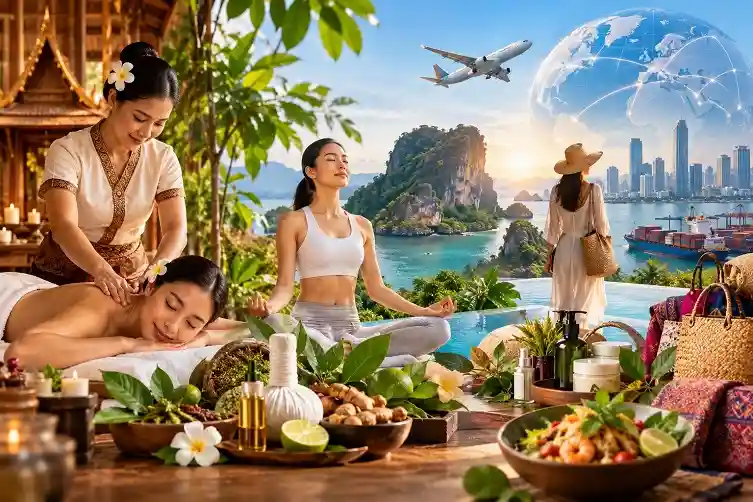
Image Credit: Thailand Wellness News
The expansion comes as wellness increasingly moves from a specialist consumer category into a mainstream global lifestyle. People are paying closer attention to physical and mental well-being, preventive health, nutrition, beauty, relaxation, and quality of life, creating new opportunities for countries with established wellness industries. In the middle of this transformation, this Thailand Wellness News report looks at how DITP plans to position Thai businesses for the next stage of international growth while building on Thailand’s distinctive combination of traditional knowledge, hospitality, natural resources, and modern health innovation.
Thailand’s Wellness Economy Reaches $42.7 Billion
Figures cited from the Global Wellness Institute show the scale of Thailand’s opportunity. The country’s wellness economy expanded by 10% in 2024 compared with 2023, increasing from US$38.8 billion to US$42.7 billion.
Thailand now ranks 24th globally and ninth within the Asia-Pacific region for the size of its wellness industry.
Several sectors are driving that position. Health tourism is the largest, with a value exceeding US$14.05 billion and a global ranking of 15th. Traditional and alternative medicine is valued at approximately US$3.23 billion, placing Thailand 18th globally, while the spa industry is worth about US$1.88 billion and also ranks 18th.
Medical spas are another rapidly expanding part of the market, recording growth of 13.8%.
These figures underline an important advantage for Thailand: its wellness economy is spread across multiple interconnected industries rather than depending on a single category. Tourism, traditional medicine, massage, spas, beauty, healthy food, herbal products, cosmetics, health services, and lifestyle products can all contribute to a wider wellness ecosystem.
DITP Wants to Turn Thai Strengths into Global Sales
DITP’s strategy is centered on converting that domestic capability into greater international commercial value.
The department has continued supporting Thai entrepreneurs through overseas trade delegations, international exhibitions, business negotiations, and programs designed to connect Thai suppliers with foreign buyers.
Its proactive 2027 plan, “Driving Thai Wellness Businesses to the Global Market,” is expected to focus increasingly on specialized opportunities rather than pursuing international expansion through a one-size-fits-all strategy.
Among the markets being targeted are luxury spas in Europe and medical services in the Middle East. DITP also sees opportunities for Thai beauty and massage services in China, while Japan presents potential for innovative food products and services and products associated with senior care.
The objective is not simply to sell more Thai products overseas. DITP is attempting to increase their value by combining Thai identity and traditional knowledge with innovation, stronger branding, contemporary packaging, science, and standards suitable for international consumers.
Overseas Trade Push Generates Hundreds of Millions of Baht
DITP’s international activities have already resulted in substantial business negotiations.
In 2025, six trade delegations involving Cambodia, Japan, Saudi Arabia, Vietnam, and two cities in China, together with participation in Cosmoprof 2024 in Hong Kong, generated trade negotiations worth 468.44 million baht.
International activities continued in 2026, with three trade delegations involving Taiwan, Japan, and Vietnam, alongside participation in Cosmoprof 2025 in Hong Kong. These initiatives generated negotiations valued at 159.60 million baht.
The numbers illustrate the commercial potential of taking Thai wellness businesses directly to international buyers, but changing conditions in established export destinations mean companies will also have to become more selective about where and how they expand.
Key Export Markets Are Showing Signs of Pressure
One of the biggest challenges facing Thailand’s wellness and herbal product sector is slowing performance in some traditional markets.
Japan recorded a decline of 15.56%, with a strong baht and sluggish economic conditions identified as pressures on the market. Australia fell by 22.25%, where household debt and high interest rates have encouraged consumers to economize.
China presents another challenge. Growth was limited to 1.05%, while younger Chinese consumers are increasingly showing a preference for domestic brands.
These developments suggest that Thai companies cannot assume that markets responsible for previous growth will continue expanding at the same pace.
Instead, businesses may have to diversify geographically while developing products with greater differentiation and higher perceived value.
ASEAN And Middle East Offer New Opportunities
While some established destinations are becoming more difficult, DITP sees significant opportunities elsewhere.
ASEAN neighbors including the Philippines, Vietnam, Malaysia, and Myanmar continue to present growth prospects. Thai products benefit from consumer confidence in their quality and, in some categories, an image of affordable luxury.
The Middle East is emerging as another particularly promising region.
Saudi Arabia recorded growth of 25.51%, while the United Arab Emirates increased by 22.82%. Consumers in these markets have strong purchasing power, with Thai fragrances and essential oils among the product categories attracting interest.
For Thai entrepreneurs, the changing geographical pattern of demand could require a major strategic adjustment. Competing primarily through volume may become less effective as consumers demand better quality, stronger branding, innovation, credible product development, and experiences tailored to specific markets.
DITP’s approach therefore calls for Thai traditional knowledge to be developed further through science and innovation, allowing companies to create higher-value offerings capable of competing internationally.
THINK THAILAND Moves Wellness to Center Stage
The THINK THAILAND: NEXT LEVEL campaign has been operating since 2024 as part of DITP’s effort to connect Thai entrepreneurs more comprehensively with international markets.
Under the concept “Thai to Global — From Local Value to Global Vision,” the campaign seeks to use creativity, innovation, quality, and distinctive Thai identity to strengthen the international image of Thai goods and services.
Sunanta Kangwalkulkit, Director-General of DITP, said the initiative focuses on creating added value while connecting businesses with opportunities overseas.
Wellness is now being positioned as an important pillar of that trade promotion strategy.
DITP is highlighting natural products, health innovations, medical and beauty services, health promotion services, health tourism, herbal products, cosmetics, healthy foods, and lifestyle goods.
This broad definition reflects the changing nature of the international wellness market. Consumers increasingly view wellness as an overall lifestyle rather than something represented by one treatment or product.
That creates an opportunity for Thailand because many of the country’s established industries can sit naturally within the wellness economy.
Popo Leads Thailand’s Wellness Campaign
DITP is also turning to prominent Thai personalities to give the campaign greater visibility.
Badminton star Sapsiree “Popo” Taerattanachai has been appointed as the wellness brand ambassador for THINK THAILAND: NEXT LEVEL.
A world champion and former world number one in mixed doubles, Sapsiree represents qualities including discipline, physical health, balanced living, professionalism, and commitment to personal well-being.
Her involvement is intended to reinforce Thailand’s image as more than a conventional holiday destination. DITP wants global consumers to recognize the country as a comprehensive wellness hub capable of combining tourism with health, relaxation, traditional knowledge, natural products, and modern services.
The campaign also connects wellness with two other major Thai industries.
Actress and model Khemanit “Pancake” Jamikorn represents fashion, highlighting an industry that combines Thai craftsmanship and cultural knowledge with contemporary design.
Singer and actor Thassapak “Bie” Chee, who has an established profile in China, represents the Thai food sector and is being used to increase international awareness and confidence in Thai food products.
Together, the three ambassadors provide recognizable faces for DITP’s broader attempt to take Thai lifestyle industries into international markets.
Global Wellness Summit Gives Thailand a Global Platform
Thailand will gain another major opportunity to showcase its wellness credentials when it hosts the 20th Global Wellness Summit from November 10-13, 2026.
The international gathering will bring together leaders from across the wellness industry to discuss its future, placing Thailand at the center of global conversations surrounding health, wellness tourism, preventive care, lifestyle, and emerging consumer expectations.
Hosting the event is particularly significant because Thailand’s position in wellness has developed over many years.
Traditional medicine, massage, natural resources, hospitality, local knowledge, health services, and a culture of holistic care have collectively contributed to the country’s international reputation.
The next challenge is turning those established advantages into greater and more sustainable economic value.
Thailand’s Next Wellness Test Is Global
Thailand’s US$42.7 billion wellness economy gives DITP a substantial foundation for international expansion, but the contrasting performance of export markets shows why the next phase will require more than relying on the country’s existing reputation. Thai businesses will need to innovate, improve quality and packaging, develop products through science where appropriate, strengthen their branding, and understand the specific expectations of consumers in different countries.
At the same time, Thailand possesses an unusual combination of traditional knowledge, tourism expertise, natural resources, hospitality, health services, food, beauty, and wellness culture. With DITP pushing those strengths into emerging markets and the Global Wellness Summit bringing international attention to Thailand in November, the country has an opportunity to translate its wellness heritage into higher-value trade and a stronger global industry presence.
For more details on DITP’s programs for the wellness industry, please visit: https://thinkthailand.ditp.go.th
or
or call: 1169