


The wellness industry has become extraordinarily good at selling the idea that almost every aspect of the human body can be measured, optimized, supplemented, tested, or hacked. Vitamins promise nutritional insurance, home tests offer unprecedented access to biological information, wearable devices turn everyday physiology into streams of data, and cold plunges are promoted as a shortcut to everything from better immunity to improved mental performance.
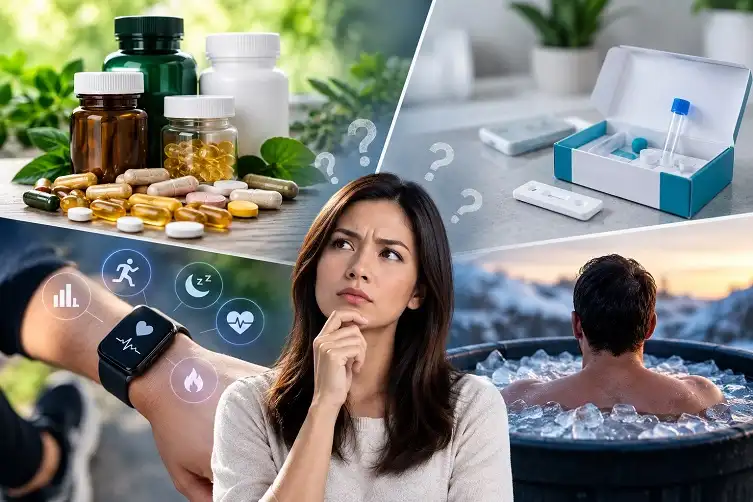
Image Credit: Thailand Wellness News
The problem is not that every wellness product or practice is useless. It is that compelling marketing can move much faster than scientific evidence. Consumers may consequently spend substantial amounts of money trying to correct problems they do not have or interpreting normal biological changes as warning signs. Midway through the growing debate, this Wellness News report examines four particularly popular trends where separating legitimate benefits from exaggerated expectations has become increasingly important.
1. Supplements Can Turn “More” Into a Health Strategy
Vitamins are essential for human health, which makes vitamin supplements remarkably easy to market. If a nutrient is necessary for the body, taking additional quantities can sound inherently beneficial.
Biology is not that simple. The original source material highlights research showing that multivitamin use has not been associated with reductions in deaths from major health conditions in large studies. It also points to evidence suggesting that certain antioxidant supplements, depending on the vitamin and dosage, may potentially increase mortality rather than reduce it.
That does not mean supplements should automatically be avoided. They can have important medical roles when a person has a genuine deficiency or another clinical indication. Vitamin deficiencies can cause serious health problems, and appropriate supplementation can be an essential part of treatment.
The important distinction is between treating an identified need and taking products because additional nutrients are assumed to provide additional protection.
A deficiency can also be a clue to an underlying medical issue. Simply purchasing a supplement may correct a laboratory number without answering the more important question of why the deficiency developed. The source emphasizes that medical professionals may investigate the underlying reason rather than merely supplying the missing nutrient.
Consumers should therefore be wary of marketing that presents supplementation as a universal route to better health.
2. Home Health Tests Can Find Problems That Aren’t Problems
Another booming area of wellness involves testing.
Consumers can increasingly order tests involving vitamins, hormones, menopause, metabolism, cancer risk, and other health indicators without first seeing a healthcare professional. It sounds empowering: collect more information about your body and use that information to become healthier.
But testing is not simply about obtaining a number. It is about understanding what that number means.
A medical test can produce false-positive results or identify abnormalities that would never have caused illness. Those findings can trigger anxiety, repeated testing, medical procedures, and sometimes treatment that was never necessary.
The original material provides a striking example involving prostate cancer screening. In a large trial discussed in the source, only around one-third of people with positive blood-test results were subsequently found to have cancer following biopsy.
This illustrates why healthcare professionals consider factors such as symptoms, age, medical history, and existing disease risk when deciding whether testing is appropriate.
Without that context, consumers can mistake screening for diagnosis.
Before buying a commercial health test, it is therefore worth asking three questions: Why am I taking this test? What will I do with the result? And who will interpret it?
If there are no clear answers, more information may create more uncertainty rather than better health. Also avoid using AI-based platforms to interpret your results! Real interpretation of health checks or screening data requires considering so many other factors including the interaction between different biomarkers etc that only a licensed medical doctor who has been monitoring your medical history for a while would be able to make a more accurate analysis than simply an AI-based app or platform!
3. Wearables Can Make Normal Biology Look Abnormal
Smartwatches, fitness trackers, sleep monitors, continuous glucose monitors, and other wearable technologies have brought medical-style data into everyday life.
For many people, this can be useful. Tracking exercise or observing general trends can encourage physical activity and greater awareness of health. But wearable technology can also encourage people to attach too much importance to numbers whose clinical significance they may not understand.
The attraction is powerful because a numerical score makes an extraordinarily complicated human body appear measurable. Sleep becomes a score. Stress becomes a number. Exercise becomes a target. Metabolism becomes a graph.
The original source warns that this can create an unhealthy relationship with data for some users, particularly when people begin obsessively pursuing step counts or exercise targets. It also notes that receiving more measurements does not automatically make someone fitter.

Image Credit: Thailand Wellness News
The issue becomes more complicated when technology developed for people with medical conditions moves into the general wellness market.
Continuous glucose monitoring demonstrates the problem particularly well. For someone with diabetes, glucose monitoring can provide medically important information. But a healthy person using the same technology may become alarmed by perfectly normal increases in blood sugar after eating.
Trying to eliminate every glucose spike could then produce unintended dietary changes. The original source raises concerns that consumers could reduce foods such as fruit, legumes, and whole grains while increasing other foods in an attempt to produce a flatter glucose graph, potentially creating a diet that is worse rather than better for cardiovascular health.
Another example in the source involved submitting essentially identical biological samples and information through two subscriptions to the same personalized nutrition service. Despite virtually matching inputs, substantially different assessments and dietary recommendations were produced.
Personalization sounds scientific, but consumers should still ask how reliably that personalization has been validated.
4. Cold Plunges Are Hot — But the Science Is Still Chilly
Cold plunges and ice baths have become one of the most visible wellness trends, promoted as ways to reduce inflammation, strengthen immunity, improve mood, manage stress, boost metabolism, sharpen concentration, and generally make the body more resilient.
Some potential benefits are supported by research, but the overall picture is far less definitive than social-media enthusiasm can suggest.
A 2025 systematic review and meta-analysis examined 11 randomized studies involving 3,177 participants exposed to cold showers, ice baths, or cold-water immersion. Researchers found a significant reduction in stress 12 hours after exposure, but that effect was not significant immediately, after one hour, after 24 hours, or after 48 hours.
Perhaps more surprisingly, cold-water immersion significantly increased inflammatory markers immediately afterward and one hour later. Researchers described this as an acute inflammatory response. The analysis also found no significant immediate or one-hour improvement in immune function.
That does not prove cold plunges are bad for people. Some studies included in the review suggested possible improvements in areas such as sleep quality and quality of life, and the physiological stress created by cold exposure may itself play a role in adaptation.
The bigger issue is certainty.
Researchers stressed that the available evidence was constrained by relatively few randomized trials, small sample sizes, differing immersion protocols, and limited diversity among study participants. Several studies also examined single immersions, making it difficult to determine the long-term consequences of turning cold plunging into a regular wellness routine.
Another scientific review published in 2025 similarly noted that direct human evidence supporting some proposed long-term metabolic benefits remains scarce.
Cold-water immersion therefore provides a useful lesson about wellness trends generally: an intervention can produce measurable biological effects without every advertised benefit necessarily being established.
Why Wellness Claims Are So Persuasive
The popularity of these products cannot simply be blamed on gullible consumers.
People may struggle to access healthcare, feel rushed during medical appointments, or believe legitimate health concerns have not received adequate attention. Wellness businesses can step into that gap with products offering something extremely attractive: control.
Conventional medicine frequently deals in probabilities and limitations. A treatment may reduce risk rather than eliminate it. Tests can be uncertain. Drugs can produce side effects. Doctors cannot promise perfect health.
Wellness marketing can offer a much more exciting story — optimization, longevity, transformation, and the possibility of becoming a better version of yourself.
Social media makes that story even more powerful. The original material notes that while formal advertising and labeling may be subject to restrictions, opinions and promotional claims can still travel through influencers, podcasts, and other channels.
The Most Effective Wellness May Look Surprisingly Ordinary
None of these concerns require consumers to reject supplements, wearables, health technology, cold plunges, or wellness itself.
The more sensible approach is to separate enjoyment from medical claims.
If someone enjoys tracking their morning run, that is different from believing a wearable can diagnose disease. Taking a cold plunge because it feels invigorating is different from assuming it will strengthen immunity or prevent illness. Taking a medically indicated vitamin is different from swallowing multiple supplements because an influencer promises longevity.
The fundamentals of wellbeing can appear disappointingly ordinary beside expensive tests and futuristic gadgets: appropriate healthcare, evidence-based screening, regular physical activity, balanced nutrition, adequate sleep, social relationships, meaningful hobbies, friendships, and community.
The original source ultimately emphasizes many of these straightforward foundations, including healthcare, appropriate screening, blood-pressure awareness, nutritious food, relationships, community, and personal growth.
Consumers should not assume that every wellness trend is fraudulent, nor that every new technology is harmful. The greater danger is allowing sophisticated marketing to outrun evidence. Supplements can be valuable when genuinely needed, tests can save lives when appropriately used, wearables can provide useful information, and cold-water immersion may offer certain benefits. But none deserves automatic acceptance simply because it looks scientific or produces impressive numbers. Asking what has actually been demonstrated, what remains uncertain, and whether qualified medical advice is appropriate can prevent wellness from becoming an expensive search for problems that were never there.
References:
https://pubmed.ncbi.nlm.nih.gov/22419320
https://pubmed.ncbi.nlm.nih.gov/17327526
https://pubmed.ncbi.nlm.nih.gov/23255568
https://pubmed.ncbi.nlm.nih.gov/38151277
https://pubmed.ncbi.nlm.nih.gov/42309145
https://pubmed.ncbi.nlm.nih.gov/30699470
https://pubmed.ncbi.nlm.nih.gov/34421490
https://pubmed.ncbi.nlm.nih.gov/36858690
https://pubmed.ncbi.nlm.nih.gov/32933842
https://pubmed.ncbi.nlm.nih.gov/35569232
https://pubmed.ncbi.nlm.nih.gov/35271177
https://journals.plos.org/plosone/article?id=10.1371%2Fjournal.pone.0317615
https://pubmed.ncbi.nlm.nih.gov/39879231