

Wellness Biohacking: Microplastics and nanoplastics have become one of the most pressing public health issues of the modern era, moving well beyond concerns about polluted oceans and overflowing landfills. Scientists now recognize that these tiny plastic fragments are not only contaminating the environment but are also making their way into the human body through the food we consume, the water we drink, and even the air we breathe. Recent studies have detected microscopic plastic particles in human blood, digestive organs, the liver, kidneys, reproductive tissues, and even the placenta, prompting researchers worldwide to intensify efforts to better understand the long-term implications of this invisible form of pollution.
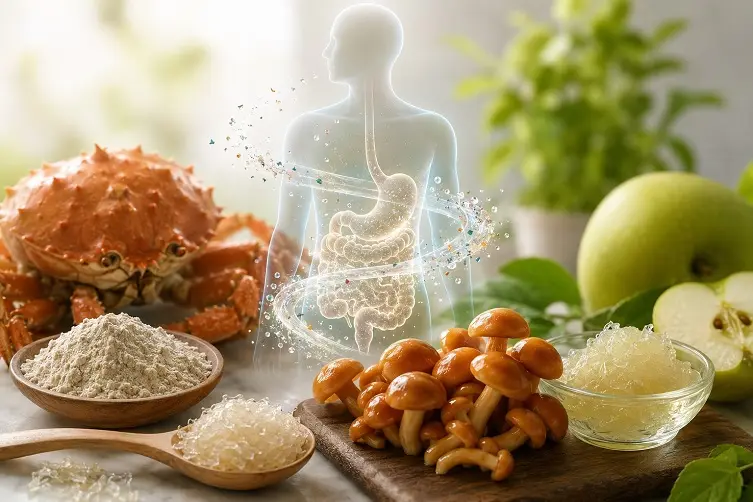
Image Credit: Thailand Wellness News
As awareness of this emerging challenge continues to grow, this Wellness Biohacking news report highlights a promising area of scientific research that is shifting attention from simply reducing environmental exposure to finding practical ways of helping the body eliminate these contaminants. Since avoiding plastics altogether has become virtually impossible in modern society, researchers are now investigating natural dietary compounds capable of binding microplastics within the digestive tract before they are absorbed into the bloodstream. Among the most encouraging candidates are chitosan and Nameko mushroom pectin, two naturally derived biopolymers that appear to work together to support the body’s natural elimination processes.
An Invisible Pollutant with Visible Health Implications
Microplastics are generally defined as plastic particles measuring less than five millimeters, while nanoplastics are significantly smaller, often measuring less than 100 nanometers. Although these particles are microscopic, their potential impact on human health is attracting increasing scientific attention.
Research has shown that after ingestion, a proportion of these particles may remain in the gastrointestinal tract for extended periods instead of passing harmlessly through the digestive system. Some investigations estimate that approximately 12 percent of ingested plastic particles can linger in the intestines for several days. Even more concerning is evidence suggesting that the smallest nanoplastics may cross the intestinal barrier, allowing them to enter the bloodstream and eventually accumulate in organs throughout the body.
Scientists are particularly concerned because prolonged exposure to microplastics has been associated with increased oxidative stress, chronic inflammation, cellular damage, and elevated cardiovascular risk. While researchers continue to investigate the full health consequences, many experts agree that reducing the body’s internal plastic burden represents an important area for future preventive healthcare.
Chitosan Emerges as a Natural Plastic Binder
Among the compounds attracting considerable scientific attention is chitosan, a naturally occurring polysaccharide derived from chitin, the structural material found in the shells of shrimp, crabs, and other crustaceans.
Chitosan has already earned recognition in medical and nutritional fields for its ability to bind dietary fats and cholesterol. However, researchers are now exploring another remarkable characteristic that could make it valuable in combating internal plastic exposure.
Once chitosan enters the acidic environment of the stomach, it develops a strong positive electrical charge. This unique property allows it to interact with negatively charged substances and certain neutral plastic polymers found within the digestive tract.
Scientists describe this interaction as functioning almost like a molecular magnet. Instead of allowing plastic particles to remain suspended within the intestines, chitosan helps bind them into larger complexes that are more easily eliminated through normal bowel movements.
One particularly significant animal study published in Scientific Reports evaluated several dietary fibers for their effectiveness in enhancing microplastic removal. Researchers reported that rats receiving chitosan supplementation demonstrated substantially greater plastic elimination compared to untreated animals.
The findings revealed that while untreated animals excreted approximately 83.7 percent of ingested microplastics over a 144-hour period, animals receiving chitosan achieved an excretion rate of 115.6 percent. This suggests that chitosan may not only assist in removing newly ingested plastic particles but could also help mobilize plastic residues that had accumulated within the intestinal tract.
Adding further interest to this growing body of evidence, a 2026 pilot study published in Biomedicine & Pharmacotherapy reported that oral chitosan supplementation significantly reduced circulating microplastic concentrations in human blood by promoting gastrointestinal sequestration before systemic absorption could occur.
Although larger human clinical trials remain necessary, these preliminary findings have generated considerable optimism among scientists investigating practical methods to reduce internal plastic exposure.
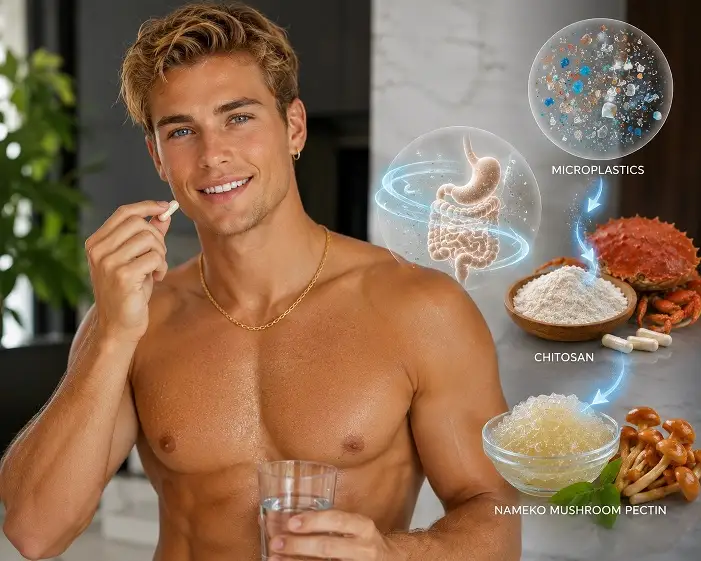
Image Credit: Thailand Wellness News
Nameko Mushroom Pectin Provides a Complementary Defense
While chitosan appears particularly effective at binding larger plastic particles, researchers believe Nameko mushrrom pectin offers an equally valuable mechanism for dealing with the much smaller and potentially more dangerous nanoplastics.
Nameko mushroom pectin is a water-soluble dietary fiber. Once it mixes with water inside the digestive system, it forms a thick, gel-like substance capable of trapping microscopic particles within its fibrous structure.
Scientists believe this gel performs an important protective role by limiting direct contact between plastic particles and the intestinal wall, thereby reducing opportunities for absorption into the bloodstream.
The science behind the pectin’s effectiveness stems from a process known as coagulating sedimentation or flocculation.
Groundbreaking environmental research led by Professor Hiroshi Moriwaki at Shinshu University demonstrated that pectin functions as an efficient biological flocculant capable of binding extremely small plastic nanoparticles. Using naturally occurring electrostatic interactions in the presence of trace dietary minerals such as iron, pectin encouraged tiny plastic particles to aggregate into much larger clusters known as flocs.
These larger aggregates become significantly easier to separate and eliminate.
Water purification experiments using this approach produced impressive results, removing up to 95.3 percent of microplastics and 87.4 percent of nanoplastics from treated samples.
Although the digestive system differs substantially from industrial water treatment, researchers believe the same underlying mechanism allows pectin to encapsulate microscopic plastic particles within the gastrointestinal tract, encouraging their safe elimination through stool rather than permitting them to migrate into body tissues.
Some researchers also say that pectin from apples can also be just as effective as pectin from Nameko mushrooms.
Working Together for Greater Effectiveness
Researchers increasingly believe that combining chitosan and Nameko mushroom pectin may offer greater benefits than using either ingredient alone.
The two natural compounds operate through different but complementary mechanisms.
Chitosan primarily relies upon its positive electrical charge to capture larger plastic fragments and various hydrophobic materials. Nameko mushroom pectin, meanwhile, forms a viscous gel capable of surrounding and clustering much smaller nanoplastics into larger structures that can be expelled more efficiently.
This dual-action strategy potentially provides broader protection across the full spectrum of plastic particle sizes commonly encountered in food and drinking water.
Equally important, apple pectin contributes additional digestive benefits that extend beyond plastic removal.
As a recognized prebiotic fiber, pectin nourishes beneficial gut bacteria that help maintain the integrity of the intestinal lining. A healthier intestinal barrier may reduce the opportunity for unwanted particles to cross into the bloodstream while also supporting overall digestive function and immune health.
This added benefit makes Nameko mushroom pectin an especially attractive candidate in comprehensive wellness strategies aimed at supporting both gastrointestinal health and environmental toxin management.
Looking Ahead at Emerging Wellness Strategies
Interest in nutritional approaches to reducing internal plastic exposure continues to expand rapidly as awareness of microplastic contamination grows around the world.
Researchers caution that neither chitosan nor Nameko mushroom pectin should be viewed as miracle solutions capable of eliminating all accumulated plastics from the body. Large-scale clinical trials involving diverse populations are still needed to establish optimal dosages, treatment durations, long-term safety, and overall effectiveness.
Nevertheless, the existing laboratory research, animal investigations, environmental science findings, and early human studies provide encouraging evidence that these naturally occurring biopolymers may represent practical, low-risk tools capable of supporting the body’s own waste elimination processes.
At a time when plastic exposure has become an unavoidable consequence of everyday life, scientific efforts are increasingly focused on helping people reduce internal accumulation rather than relying solely on environmental avoidance. The continuing investigation of chitosan and apple pectin represents an important step toward developing evidence-based nutritional strategies that may eventually become valuable additions to preventive wellness programs around the world.
The growing body of research surrounding these two natural compounds illustrates how nutrition science continues to evolve in response to emerging environmental health challenges. While further clinical evidence remains essential before definitive medical recommendations can be made, the available findings suggest that supporting the body’s natural digestive processes through carefully studied dietary fibers may offer a realistic and accessible approach to reducing microplastic exposure. As scientists continue to deepen their understanding of how these invisible pollutants interact with human biology, natural interventions such as chitosan and Nameko mushrrom pectin could become increasingly important components of future wellness strategies.
References:
https://www.nature.com/articles/s41598-025-96393-w
https://www.mdpi.com/2039-4713/16/3/92
https://www.sciencedirect.com/science/article/abs/pii/S0045653526000962
https://www.shinshu-u.ac.jp/english/topics/2026/04/nameko-mucilage-an-e.html
https://www.sciencedirect.com/science/article/abs/pii/S2213343722009277
For the latest Wellness Biohacking strategies, keep on logging to Thailand Wellness News.
Medical Disclaimer: All content published by Thailand Wellness News is based on scientific research and is intended for informational and educational purposes only. It is not medical advice, diagnosis, or treatment. Readers must not attempt to use, apply, or experiment with any protocols, compounds, or therapies mentioned without first consulting a qualified and licensed medical doctor. Many findings discussed are experimental or preliminary, and only a licensed healthcare professional can determine what is safe and appropriate for an individual’s specific medical condition.