Thailand Wellness News: Bo Suak and Nan Emerge as Blueprint for Wellness Communities
Thailand’s ambition to become a global Herbal and Wellness Hub is steadily taking shape on the ground, and nowhere is this clearer than in Nan Province. The Department of Thai Traditional and Alternative Medicine has formally advanced the “Bo Suak Model” as a prototype Wellness Community, positioning it as a scalable framework that transforms local health wisdom into a powerful grassroots-driven economy with national reach. By weaving together traditional medicine, community enterprises, and wellness tourism, Nan is fast becoming a living example of how heritage and innovation can coexist sustainably.
Officials recently toured Bo Suak Subdistrict and Ban Nam Kien, identifying both communities as exemplary ecosystems where wellness is not merely a concept but a daily practice. These areas demonstrate how local herbs, cultural knowledge, and community participation can be organized into structured, income-generating systems that also appeal to health-conscious travelers.
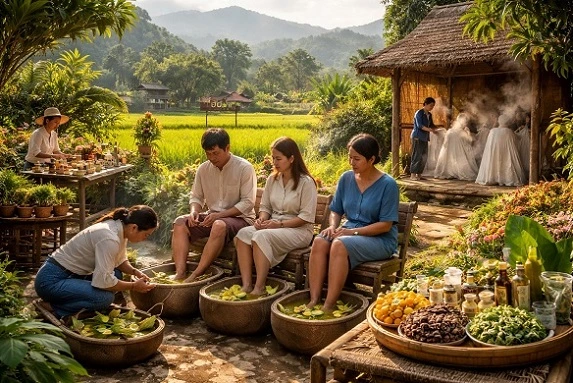
Image Credit: Thailand Wellness News
This Thailand Wellness News report observed that the model is not focused on mass tourism, but on immersive health experiences that preserve authenticity while meeting modern standards.
Local Wisdom Meets International Standards
Dr. Pongsathorn Phokphermdee, Director-General of the Department of Thai Traditional and Alternative Medicine, explained that Bo Suak stands out for its ability to elevate indigenous herbs into innovative, internationally acceptable products. Community enterprises have successfully processed miang leaves into mouthwash and herbal tea, showing how traditional ingredients can be adapted for modern wellness markets without losing their cultural roots.
Beyond products, Bo Suak has curated hands-on health activities rooted in Thai traditional medicine. Visitors can experience herbal fumigation to ease colds and allergies, herbal foot baths using lemongrass, ginger, and salt to stimulate circulation, and knee poultices popular among the elderly for reducing inflammation and muscle tension. Organic mulberry leaf tea, known for nourishing the body and helping regulate blood sugar, adds another layer to the community’s holistic approach.
Ban Nam Kien Sets the Bio Lifestyle Standard
Complementing Bo Suak’s traditional focus, Ban Nam Kien represents a more contemporary herbal bio-lifestyle model. The community hosts a nationally recognized herbal cosmetics manufacturing facility and offers an integrated one-stop wellness service. These include Wellness Stay accommodations, the Krua Muan Chub healthy food restaurant, and herbal and cosmetic products certified by the Ministry of Public Health. Together, these elements demonstrate how wellness communities can diversify revenue while maintaining strict safety and quality controls.
Structured Criteria for Sustainable Health Tourism
According to Dr. Pongsathorn, Nan Province is exceptionally prepared for wellness tourism, supported by high-standard travel routes linking wellness centers, accommodations, restaurants, and medical facilities. More than 105 “Nan’s Healthy Food” initiatives allow visitors to engage fully in a community-based health lifestyle rather than a superficial tourism experience.
To ensure consistency and credibility nationwide, the Department has introduced clear Wellness Community Assessment Criteria. These include a strong Thai traditional medicine identity, robust network connectivity across tourism and healthcare services, and sustainability requirements covering mental well-being, culture, learning resources, health promotion, safe agriculture, and environmental management. Communities must meet at least five of these six sustainability components to qualify.
A Living Health Economy Rooted in Thai Wisdom
At its core, the Thai Wellness Community Model rests on three pillars: healthy food made from safe local ingredients, herbal remedies and wellness products innovated to generate community income, and standardized traditional handicrafts that are both safe and culturally meaningful. These elements are not designed solely for tourism, but function as a practical system for improving everyday health while strengthening local economies.
The Bo Suak Model shows that when traditional wisdom is respected, structured, and supported by policy, it can evolve into a resilient health economy that benefits residents and visitors alike. More importantly, it demonstrates that sustainable wellness begins within communities themselves, offering a roadmap for Thailand’s future as a global wellness destination built on authenticity rather than imitation.
For the latest on new wellness initiatives in Thailand, news, keep on logging to Thailand Wellness News.