


Thailand Wellness News: A growing body of scientific evidence is now showing that massage therapy does far more than relax sore muscles. A new comprehensive review has revealed that structured massage touch can directly change brain activity and even support long-term brain adaptation, offering fresh insights into how hands-on therapies influence mental health, pain, and development.
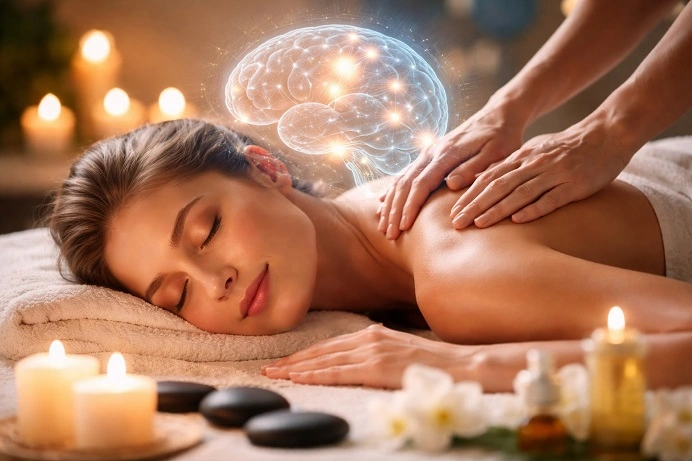
Image Credit: Thailand Wellness News
Scientists Examine Massage Effects on The Brain
Researchers from the Institute of Neurofeedback and tDCS Poland, Szczecin, Poland, and the Department of Nursing, Faculty of Nursing and Midwifery, Wrocław Medical University, Wrocław, Poland, analyzed decades of human studies to understand how massage affects the brain. They examined research using advanced brain-monitoring tools including electroencephalography, functional MRI, and functional near-infrared spectroscopy.
This Thailand Wellness News report highlights that the researchers reviewed 47 high-quality human studies conducted between 1990 and 2025, involving healthy adults, patients with chronic pain, stressed individuals, elderly populations, children, and even premature infants.
Immediate Brain Changes Linked to Relaxation and Pain Relief
One of the most consistent findings was that massage rapidly alters brain waves linked to relaxation. Many studies showed increases in alpha brain waves, which are commonly associated with calm alertness and reduced stress. At the same time, faster brain waves linked to anxiety and mental strain often decreased.
In people experiencing pain, massage was shown to reduce chaotic brain activity and shift the brain toward slower, more organized patterns. These changes closely matched reductions in pain intensity and emotional distress, suggesting that massage directly calms pain-processing networks in the brain rather than acting only on muscles.
Brain Networks Respond to Touch
Brain imaging studies revealed that massage activates areas involved in body awareness, emotional regulation, and pain control. Regions such as the insula, anterior cingulate cortex, and brainstem pain-modulation centers became more balanced after massage sessions. In chronic pain patients, repeated treatments helped normalize disrupted brain networks that are often linked to persistent discomfort.
Interestingly, the studies also showed that moderate pressure was key. Gentle but firm touch produced the strongest calming effects, while very light or mechanical stimulation sometimes led to more alert or mixed brain responses.

Image Credit: StockShots
Long Term Brain Adaptation and Developmental Benefits
Beyond short-term effects, repeated massage sessions appeared to support long-term brain adaptation. In adults, ongoing treatments reduced stress hormone responses while improving emotional stability and performance under pressure. One study even reported increased levels of brain-derived neurotrophic factor, a molecule linked to brain health and learning.
Perhaps most striking were findings in premature infants. Regular massage helped their brains mature faster, leading to more stable and organized brain activity patterns. This suggests that early tactile stimulation may play a vital role in healthy brain development.
What The Findings Mean for Healthcare
Overall, the review confirms that massage is not just a comfort therapy but a powerful sensory input capable of reshaping brain function.
Conclusions
The evidence clearly shows that massage influences the brain in measurable and meaningful ways. It can calm stress circuits, reduce pain-related brain disruption, and promote healthier brain development when applied repeatedly. These findings strongly support integrating massage into pain management, mental health care, rehabilitation programs, and neonatal medicine, while also highlighting the need for larger long-term studies to refine treatment approaches.
The study findings were published in the peer reviewed Journal of Clinical Medicine.
https://www.mdpi.com/2077-0383/15/2/909
For the latest on the benefits of massage therapy, keep on logging to Thailand Wellness News.
Medical Disclaimer: All content published by Thailand Wellness News is based on scientific research and is intended for informational and educational purposes only. It is not medical advice, diagnosis, or treatment. Readers must not attempt to use, apply, or experiment with any protocols, compounds, or therapies mentioned without first consulting a qualified and licensed medical doctor. Many findings discussed are experimental or preliminary, and only a licensed healthcare professional can determine what is safe and appropriate for an individual’s specific medical condition.